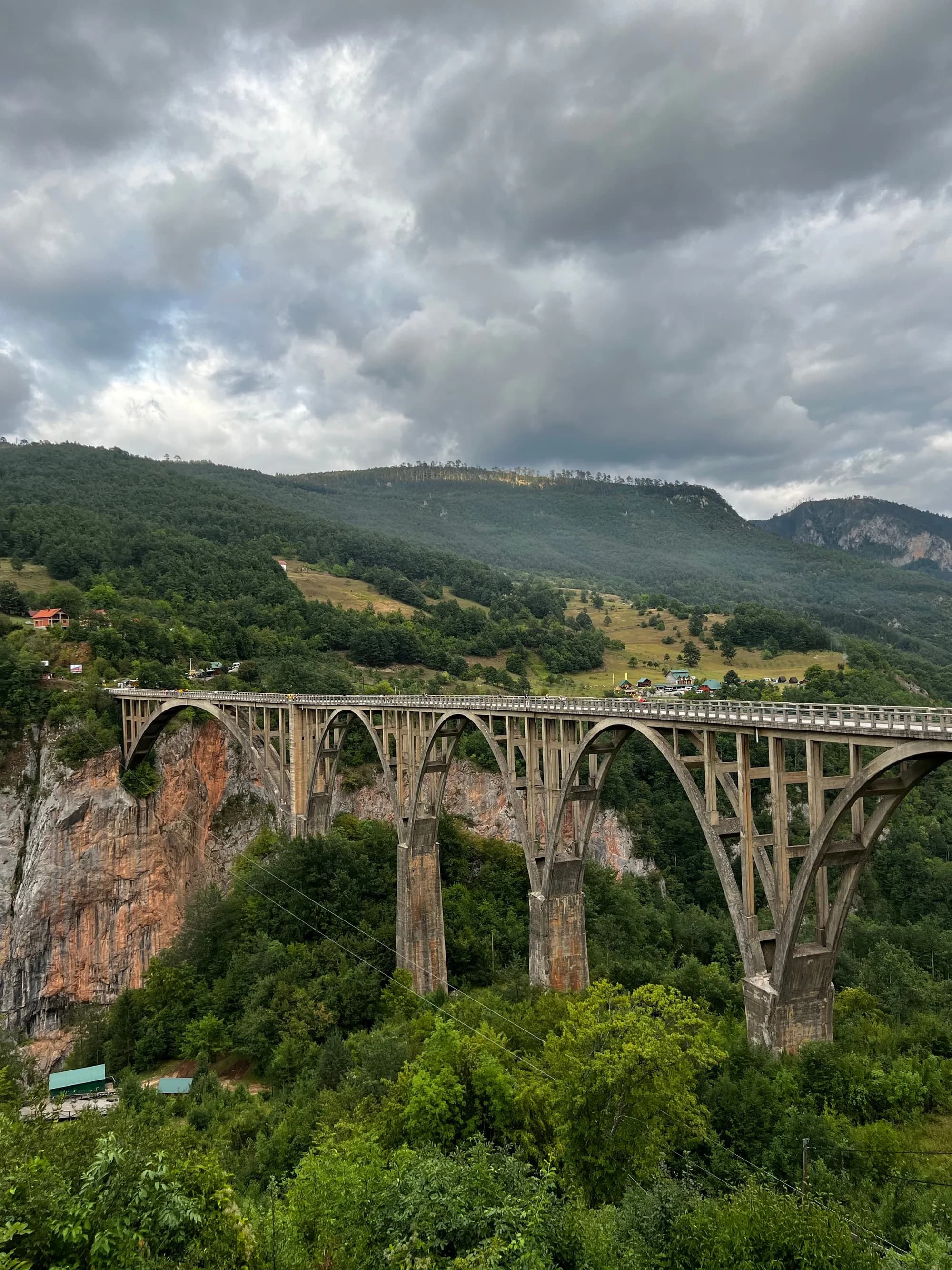
The municipality of Pljevlja occupies an area rich in rivers, canyons, plateaus and old road routes. Due to such a geographical position, the bridges in the Pljeval region have a special meaning: they are not just crossings over water, but buildings that connect distant villages, mountainous areas, trade routes and tourist areas. Among them, the Đurđevića Tara Bridge stands out, one of the most famous bridges in Montenegro and a recognizable symbol of the north of the country.
The bridge on the Đurđevića Tara is located on the Pljevlja-Žabljak main road, above the canyon of the Tara river, between the villages of Budečevica and Trešnjica. It was built from 1937 to 1940, and was designed by engineer Mijat Trojanović. At the time it was completed, it represented a major construction feat, as it had to bridge the deep Tara canyon and connect areas that were previously difficult to access. The bridge is about 365 meters long, has five arches, and its most impressive arch rises high above the river, which is why it still leaves a strong impression on visitors today. The significance of this bridge is not only in its architecture. It has become a symbol of human courage, engineering knowledge and the ability to overcome one of the most demanding natural areas in Montenegro. Its arches fit harmoniously into the landscape of the canyon, so the bridge seems to be both a building and a part of nature at the same time. Precisely because of this, today it represents one of the most famous tourist spots in the north of Montenegro, a place from which there is a view of Tara, Durmitor and the surrounding mountain areas. The bridge on Đurđevića Tara has a strong historical and memorial meaning. During the Second World War, partisans demolished part of the bridge in 1942 in order to stop the movement of occupying forces across the canyon. Engineer Lazar Jauković, one of the people who participated in the construction of the bridge, and later in its partial demolition in order to prevent the enemy's advance, is especially remembered in that action. After he was captured, he was shot on the bridge, so this space became a place of memory for sacrifice, resistance and the fight for freedom. That is why the Đurđevića Tara Bridge is not only a tourist attraction, but also a monument to history and human determination. In addition to this monumental bridge, the bridges on the Ćehotina, a river that passes through various parts of the municipality and shapes the life of numerous villages, are also important for the Pljeval region. ijehotina is important for Pljevlja not only as a natural stream, but also as an area around which roads, settlements, picnic areas and local everyday life developed. That is why the smaller bridges over this river have a special value, because they speak of the connection of people with the space in which they live. Among such examples are the suspension bridges over Ćehotina, such as the bridges in Prošće and Jelica. They do not have the monumentality of the Tara Bridge, but they are very important for the local population, because they connect the coasts, villages, estates and people who use the space along the river. Such bridges serve the locals, foresters, hunters, fishermen and everyone who moves through the villages of Pljevlja. Their symbolism is different: they represent everyday life, rural connectivity and the need to keep remote areas from being cut off from the city and from each other. The area of Gradac, along the Ćehotina river, has a special meaning, where bridges have the role of connecting settlements and preserving life in the rural parts of the municipality. In such environments, the bridge is not only a traffic facility, but a condition for normal life, for going to the farm, forest, road, school, work or city. When bridges are restored or replaced, it shows how important they are to the survival of local communities and how much a river, although a natural beauty, can be an obstacle if there is no safe crossing. The bridges of Pljevlja therefore show two pictures of this municipality. The bridge on Đurđevića Tara represents the grandeur of nature, an engineering feat, tourism and historical memory. The bridges on Ćehotina represent a more peaceful, but equally important story, a story about villages, everyday life, the connection of people and the survival of life along the river. Together, they speak of Pljevlje as a space where bridges connect not only coasts, but also mountains, villages, history, nature and people.