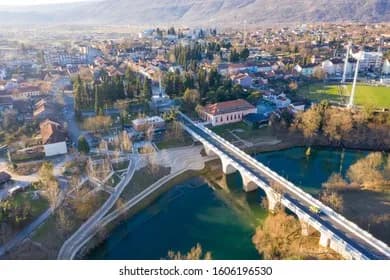
Danilovgrad was created and developed along the Zeta River, in the area of the Bjelopavlić plain, where bridges played a major role in connecting the coasts, settlements and important road routes. For this region, bridges were not only technical structures, but important conditions for the development of the city, trade, daily life and the connection between Stara Crne Gora, Brdo and the surrounding areas.
The most important bridge in Danilovgrad is the Radovan Pavićević Bridge, also known as Mirkov's Bridge. It is located on the Zeta River and is one of the symbols of Danilovgrad. Its construction is related to the period of the foundation of the new town in Bjelopavlići, when Prince Nikola started the planned development of Danilovgrad. The construction of the bridge over the Zeta was one of the key steps in the creation of the city, because it enabled a safer connection of the two banks and a stronger connection between Stara Montenegro and Brdo. This bridge is also special because it cannot be separated from the very idea of the origin of Danilovgrad. While public buildings, streets and a new urban space were planned, the bridge over the Zeta had a central place in connecting the future town with its surroundings. That is why the Mirkov bridge is not just a crossing over the river, but part of the urban and historical identity of the city. Although it was reconstructed over time and adapted to modern traffic, it retained the value of the old stone bridge and remained one of the most recognizable motifs of Danilovgrad. Adžija's bridge in Miokusovići, on the river Sušica, has a special place among old bridges. It is a stone bridge from the Turkish period, which is registered as part of the cultural heritage of Danilovgrad. Unlike the city bridge on the Zeta, Adžija's bridge is smaller and more hidden from the main roads, but that is precisely why it bears an authentic image of the old road and the former way of life in Bjelopavlići. Adžija bridge is mentioned as a bridge on the old route of the caravan road that connected Shkodër, Duklja and Nikšić. It was built of finely carved stone, with one high arch above Sušica. There is no reliable information about the exact year of its construction, so it is most correct to associate it with the Ottoman, that is, the Turkish period. Its value is that it preserves the memory of old road routes, caravans and the time when such stone bridges were crucial for the movement of people and goods through the interior of Montenegro. In the Danilovgrad region, the Jelena of Anžujska Bridge is also mentioned, which is located a few kilometers from the city and is associated with local legends. For this bridge, it is particularly important to emphasize that its meaning is largely related to legend and folk memory. According to legend, the bridge is associated with Helen of Anjou, a medieval queen about whose origin there are different stories. Although such stories should not be presented as completely confirmed historical facts, they show that the bridge has a special place in the local consciousness as part of the tradition and cultural memory of the region. Smaller bridges on the Zeta, such as the bridge in Dobro Polje, are also important for the daily life of the population. They do not have the same historical recognition as the Mirkov or Adžija bridges, but they have a clear local significance, because they connect settlements, estates and river banks. Such bridges remind us that the importance of a building is not always measured only by its age or monumentality, but also by how important it is to the people who use it every day. Together, the bridges of Danilovgrad speak of the space that was created along the river and the roads. The Mirko bridge represents the development of the modern town and the connection of the Bjelopavlić plain, the Adžija bridge preserves traces of older road routes and the Ottoman period, the Jelena Anžujska bridge carries a layer of legend and local memory, while the smaller bridges on the Zeta are important for the daily life of the population. That is why the bridges in Danilovgrad can be seen as an important part of the municipality's identity, as a link between the coasts, history, traditions and life in the Zeta valley.