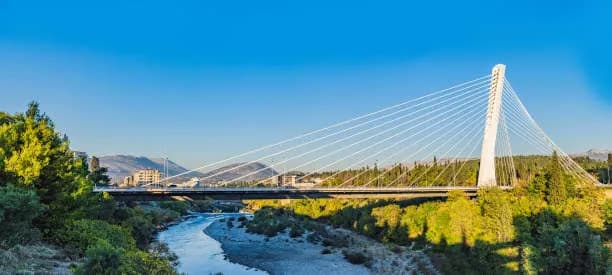
Podgorica developed on the banks of Morača and Ribnica, so the bridges in its area have a special meaning. They connect not only the shores, but also different historical layers of the city, from old Podgorica and the Ottoman heritage, through post-war construction, to the contemporary identity of the capital.
One of the oldest and most famous is the Old Bridge on Ribnica, also known as the Sastavci Bridge or Adži Pasha's Bridge. It is located near the mouth of Ribnica in Morač, in the area of Sastavak, which is often associated with the old Podgorica. It is believed that the bridge originates from a very early period, and was later restored during the Ottoman rule. The renovation is most often associated with Adži Pasha Osmanagić, after whom the bridge got one of its names. Its value is not only in its age, but in the fact that it represents one of the most recognizable traces of old Podgorica. The modest stone appearance and location next to Ribnica give it a special symbolism of a place where history, the river and the daily life of the city come together. An important place in the collective memory of Podgorica is also the Vizier's Bridge on Morača. The Old Vizier's Bridge was one of the important crossings over Morača and played a major role in connecting the town with the routes to Spuž, Nikšić and Stara Montenegro. It was related to the Ottoman period and old road communications. Over time, it lost its original appearance, and after being damaged in the Second World War, a new bridge, known as the Vak Đurović Bridge, was built on that area. Nevertheless, the name Vizier's Bridge remained present in the speech and memory of the citizens, as a reminder of the old Podgorica and the former roads across the Morača. One of the symbols of the post-war development of the city is the Blaž Jovanović Bridge, built in the fifties of the 20th century, in the period when Titograd was rapidly being renovated and expanded. It was designed by Branko Žeželj, a well-known construction expert, and the bridge was named after Blaž Jovanović, a national hero and an important political figure of that time. This bridge symbolizes the transition from old Podgorica to the modern urban center and for decades was one of the key traffic routes across Morača. The most recognizable modern bridge in Podgorica is the Millennium Bridge, opened on July 13, 2005. It was designed by Mladen Ulićević, and the bridge is recognizable by its tall pylon and sloping cables. In contrast to the older stone bridges, Millennium represents contemporary architecture and a new visual identity of the city. Due to its appearance and location, it has become one of the main symbols of Podgorica and is often perceived as a sign of its modern development. Near the Millennium there is the Moscow Bridge, a pedestrian bridge over the Morača. Its construction is linked to the gift of the city of Moscow, which is why it carries a special meaning of friendship and cultural ties. Unlike the monumental Millennium Bridge, the Moscow Bridge has a more peaceful, pedestrian character and serves as a space for daily movement, walking and connecting parts of the city. The bridges of Podgorica together speak of the development of the city over time. The old bridge on Ribnica preserves the spirit of the oldest Podgorica, the Vezirov bridge reminds of the Ottoman period and the old roads, the Blaž Jovanović bridge of post-war construction, while the Millennium and Moskovski bridge represent modern Podgorica. That is why they are not just river crossings, but symbols of history, identity and urban development of the capital city.