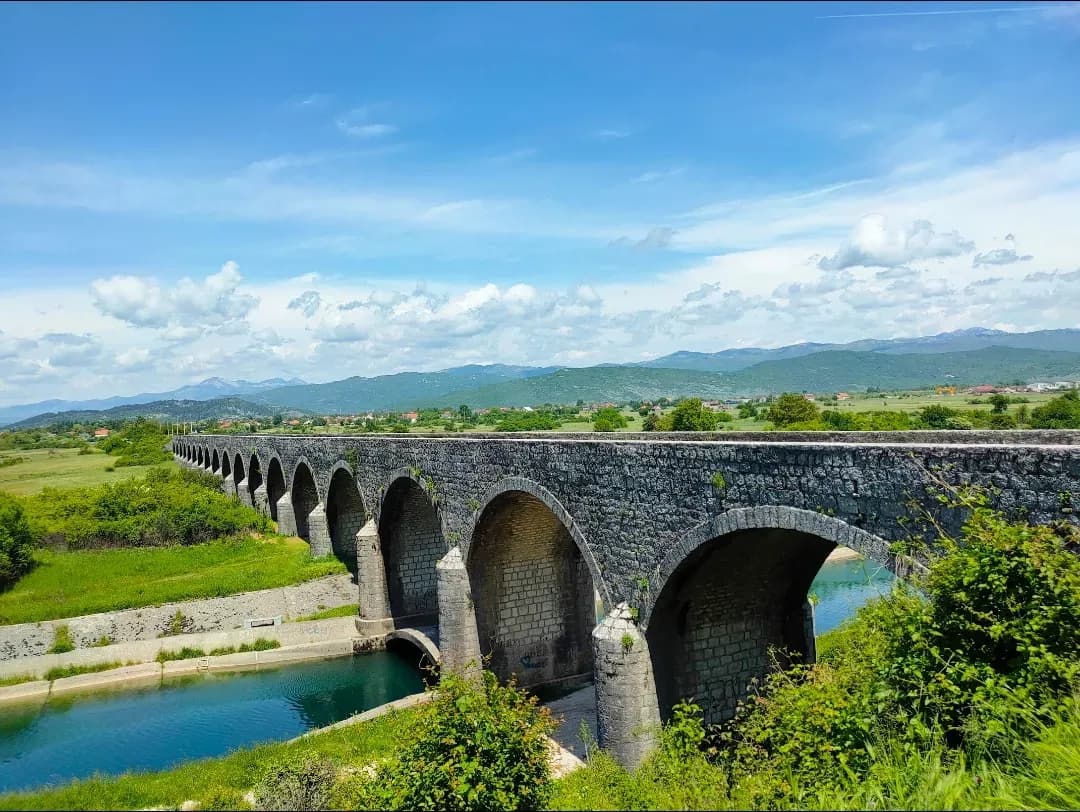
Nikšić is a city whose history is not only made up of fortresses, squares and temples, but also bridges that connected coasts, settlements, roads and people for centuries. Due to its location, numerous watercourses and old traffic routes, the Nikšić region has been a meeting place of different cultures and historical eras since ancient times. That's why the bridges in Nikšić are not just buildings built to cross rivers, but valuable traces of time, from ancient heritage, through the Ottoman period, to the modernization of Montenegro in the 19th century.
A special place is occupied by the Bridge on Moštanica, also known as the Roman Bridge. It is considered the oldest preserved bridge in Montenegro and one of the most important traces of ancient heritage in the area of Nikšić. Although there are no completely reliable data on the exact year of its construction, it is most often associated with the Roman period, that is, with the 3rd century. It is assumed that it was part of the old road communication that connected the coast, the Nikšić region and the wider area towards Shkodër. It was built of stone, with distinctive vaults, and over the centuries it has been renovated and extended several times. Its value also lies in the fact that it is a symbol of the continuity of life in this area. The Moštanica bridge is also in the lower part of the coat of arms of the Municipality of Nikšić, which further confirms its importance for the city's identity. Among the most famous bridges of Nikšić is the Emperor's Bridge on the Zeta, a monumental stone building from the end of the 19th century. It was built at a time when Nikšić, after liberation from Ottoman rule, was developing as a modern city center. Its construction was initiated by Prince Nikola Petrović, and the project is linked to the architect Josip Slade. The bridge was important because it enabled a better connection of Nikšić with the direction to Danilovgrad and Podgorica, especially through the area of Slivlj, where the Zeta River, marshland and floods made passage difficult. It is about 269 meters long and is recognizable by a series of stone arches. The name Emperor's Bridge is associated with the Russian Emperor Alexander III Romanov, whose help was significant for its construction. The bridge was officially opened on October 20, 1894, and according to tradition, the news of the emperor's death arrived on that very day. That's why this building has a special symbolic meaning: it represents gratitude, friendly ties between Montenegro and Russia, but also the ambition of Montenegro at the time to build permanent public facilities and develop modern infrastructure. The Hadži Ismail bridge on Dukla, known as the Hadž bridge, is also significant. It is located on the Zeta River and dates back to the beginning of the 19th century. It was built by Nikšić merchant Hadži Ismail Lekić, also known as the founder of the Hadži Ismail Mosque. The bridge was an important part of the old caravan routes that connected Nikšić with Gack, Mostar, Foča and Višegrad. It is about 110 meters long and has eight semicircular openings. Its importance lies in the fact that it bears witness to the commercial life of Nikšić, the Ottoman period and the city's connections with the wider area of Herzegovina and Bosnia. In the area of Nikšić, the Vuk bridge has a special place, which is located on the site of the former Beg bridge. Important roads to Risno and Trebinje led through that direction. The old bridge was demolished at the beginning of the 19th century, and a new one was built in 1888, on the initiative of Prince Nikola. It is named after Vuk Mićunović, the famous Montenegrin hero from "Mountain Wreath". This gave the bridge a strong symbolic dimension, as it represents not only a renewed crossing, but also a reminder of the Montenegrin epic tradition, heroism and collective memory. The Gorda bridge on Bistrica, built in 1902, has a different but very valuable story. It was built by Gorda M. Filipović, a well-known philanthropist from Nikšić, so that children from Dragova Luka could cross the swollen Bistrica more safely, especially during the winter. Unlike large bridges that were built for state, military or commercial needs, the Gorda bridge was created out of concern for the everyday life of citizens. That is why its symbolism is particularly humane, it represents solidarity, charity and responsibility towards the community. The bridges of Nikšić together form a kind of stone chronicle of the city. The bridge on Moštanica speaks of ancient roots, Hadži Ismail's bridge about trade and Ottoman heritage, Vuk's bridge about epic tradition, Tsar's bridge about modernization and state development, and Gorda's bridge about charity and local care for people. Each of them has its own story, and together they show that the history of Nikšić is preserved not only in large monuments, but also in bridges that connected people, regions and eras.