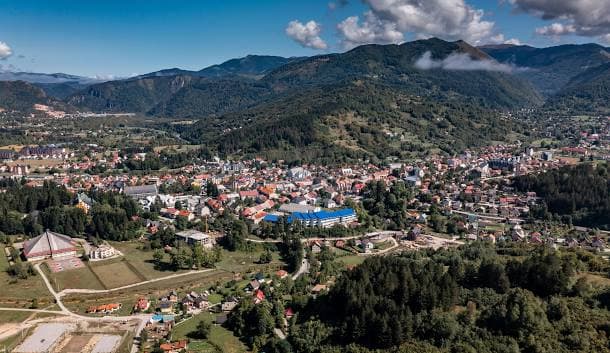
Kolašin does not have preserved fortresses, ramparts or walls that would testify to a classic fortified city today. Nevertheless, its oldest part and the way in which the city developed speak of an area that had strategic importance since its inception.
It is located in the valley of the Morača river, on an important mountain road, and was originally formed as a fortified settlement during the Ottoman period. The city was originally built as a stone Turkish fortress in 1647, which had a military-strategic role in controlling movement through this part of northern Montenegro. After the liberation in 1878, that fortress was demolished according to plan, and its stone was used to build the new city core, including today's narrower urban area, the monumental Memorial Home and the Native Museum on Trg boraca. Thus, the material structure of the old fortification disappeared, but its physical "imprint" remained embedded in the modern city. The role of this area was the control and supervision of movement through this part of northern Montenegro, which gave it importance without the need for monumental fortifications that have been preserved today. Today, the historical layer of that settlement can be recognized in the inner city center, especially in the area of the Fighters' Square, where the urban core from which Kolašin developed is located. Although without the physical remains of the fortress, this area still preserves the spirit of the old settlement through its layout, location and continuity of life. It is this combination of history, location and natural environment that makes Kolašin special as a city whose "fortresses" are not seen in the stones, but in the story and the space that has survived through the centuries. A visit to the old city center of Kolasin offers an opportunity to experience the city in a different way through its origin, development and historical significance. A walk through this part of the city allows you to feel the authentic atmosphere of a mountain settlement that grew up at an important crossroads, but kept the peace and simplicity of its space. It is an ideal place for visitors who want, in addition to natural beauty, to get to know the historical side of Kolašin, as well as to understand how a small mountain center has become an important part of the cultural and tourist offer of the north of Montenegro.