Cetinje was founded in 1482 by Ivan Crnojević and since then has become the main political and spiritual center of Montenegro. Unlike many old cities on the coast that had walls and towers around them, Cetinje never had such city walls. The reason for this was the location of the city. Cetinje is located in a closed mountain valley, surrounded by mountains, which naturally protected it. Instead of walls, the main place of assembly and protection of the state was the Cetinje monastery, which had the role of both a church and a state center. Later, in the 19th century, Cetinje developed into a modern capital. Buildings for the state administration, foreign embassies and the court are being built, so the city takes on the appearance of a real political center. Nevertheless, even then, it remains without classical walls, because its natural position and state organization did not require it. Today, Cetinje is one of the most important cultural and historical places in Montenegro, and visitors come for the museums, monasteries and the old capital. However, when looking at the wider area of the Capital, it can be seen that the history of this area does not end only in the city itself. There are also important older fortifications around Cetinje that played a role in the defense and control of the approaches to the capital during different periods. Those places are not part of the city core, but they are directly connected with its development and the way this area has functioned throughout history. Below are the two most important locations in the area of the Capital of Cetinje, which still have a special historical and touristic significance.
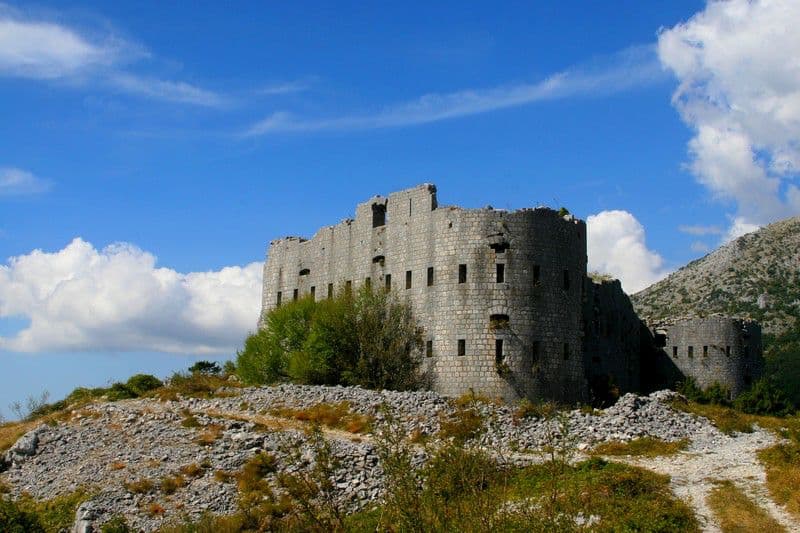
Kosmač fortress The Kosmač fortress is located above the road connecting Budva and Cetinje, in the area of Brajić. It was built between 1841 and 1850 by Austria-Hungary. Its main purpose was to control the road leading from the sea to Cetinje. From that place it was possible to follow every movement of people and the army that were going towards the then Montenegrin capital. The fortress was built of stone, very solid, and housed an army that had the task of guarding the border and reacting in case of danger. Living conditions were difficult because the fortress was isolated and exposed to mountainous conditions. Today, Kosmač is abandoned and partially demolished, but it is still interesting for tourists. People come for the view of the sea and the mountains, as well as the fact that it is one of the few places where you can see old military construction in the mountains. Obod fortress The Obod fortress is located above Rijeka Crnojevića and originates from the 15th century, from the time of the rule of the Crnojević dynasty. Its role was to guard the passage through the valley and to control the important roads that connected the interior of the country with Lake Skadar and Cetinje. At that time, it was a very important position for managing the state and trade. The first important cultural activities developed near Obod, including one of the first printing presses among the South Slavs. Today, only parts of the walls remain, but the place is still very visited. Tourists come for the view of the Rijeka Crnojevića canyon and because it is one of the oldest historical places in this region. In the area of the Capital of Cetinje, there are not many preserved large old fortifications except for Kosmač and Obod. Throughout history, this entire area was more protected by nature and mountains than by walls. That is why the most important points were in strategic places, and not in the city itself. The old fortifications in the area of Cetinje show how this area was defended through different periods of history. The rim shows the time of the Middle Ages and the Crnojevic dynasty, Kosmač shows the later period and military control by Austria-Hungary, while Cetinje represents the capital that developed without walls, relying on its natural position and state organization.