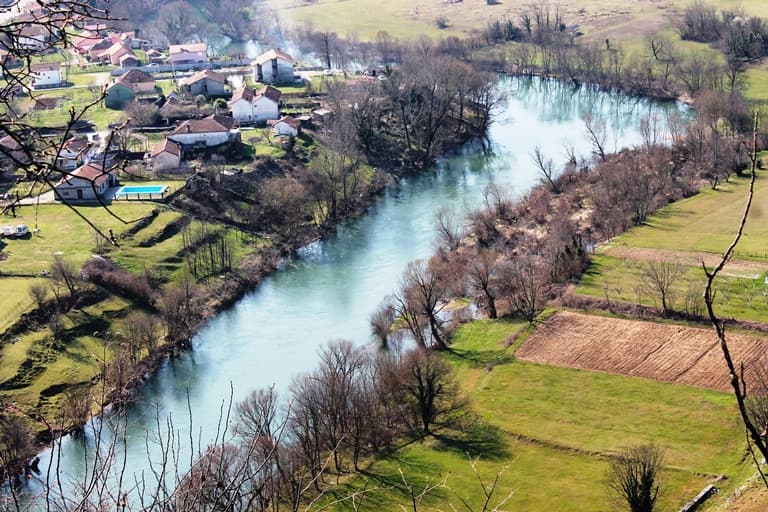
The municipality of Danilovgrad is located in the very central part of Montenegro, in the spacious, fertile and picturesque valley of the Zeta River, better known as the Bjelopavlić Plain. Throughout history, this area has had a first-class strategic and geographical position, because it represents a natural passage, a communication lifeline and the most important link that connects the mountainous interior of the country with the Montenegrin coast. Although the city of Danilovgrad itself is a younger urban settlement from the 19th century, its wider area hides extremely important and deep traces of the past. This is especially true of the historical zone of Spuž, where complex military and defense systems have been created and developed for centuries. It is these sites that testify to the geopolitical importance of this region through different historical periods, functioning as an eternal battlefield and a key gateway for the control of the entire region.
- Spuška glavica – The strategic eye of the Bjelopavlić plain Above today's village of Spuž, on a lonely and sharp limestone hill known as Spuška glavica, rise the monumental remains of the old Spuška fortress. Although it is in ruins today, this fortification complex still leaves a strong, almost dramatic impression on anyone who visits it. The choice of this location was an ingenious military move: from this dominant hill there is an unobstructed, panoramic view of the entire plain, the bed of the Zeta River and the approaches to Podgorica and Nikšić. The fortress in its modern form was built during the Ottoman domination, and its foundations were laid at the end of the 17th century under the order of the pasha of Skadar, and it gained its full splendor and monumentality during the 18th century. The roads that passed through the Zeta Valley were vital for trade and military campaigns, so this area had to be under continuous, rigorous surveillance. Spuž was therefore turned into a powerful military fortification, a border base and a key Ottoman rampart that had the task of stopping the liberation aspirations of Montenegrin and highland tribes.
- Architectural marvel of twenty-four towers The uniqueness and military strength of the Spuška Fortress were reflected in its impressive size and specific internal layout. According to preserved historical descriptions and folk tradition, this fortress had as many as twenty-four defensive towers (bastions). They were geometrically precisely arranged along elliptical stone walls so that they covered literally every inch of the environment, eliminating any blind spot for potential attackers. These towers served not only as observation posts with loopholes and cannon holes, but were designed as independent defensive units. They were connected to each other by massive, thick walls, underground passages and protected paths, forming a unique and at that time practically impenetrable system of protection. Inside the fortress there were also deep stone buckets (cisterns) for water, ammunition depots, gunpowder and barracks for the accommodation of permanent military garrison. Such a complex arrangement speaks of the enormous attention that was paid to its construction and the imperial importance that Spuž had for the Ottoman Empire.
- Life Behind the Walls – The Scene of Historical Conflicts
Life in and around the Spuška Fortress was completely subordinated to military discipline and strategy. For decades, the entire traffic of people and goods was strictly controlled from its walls, and Spuž has long been considered one of the most fortified and important military points in the entire Western Balkans. It is precisely because of this position that this fortress has been constantly in the center of great historical events and bloody conflicts that have directly shaped the fate of modern Montenegro. The surroundings of Spuž and the Zeta valley itself were the scene of famous battles, such as those at Martinići and Krusi, and the Montenegrin rulers of the Petrović-Njegoš dynasty, especially St. Peter of Cetinje and Njegoš, recognized Spuž as the main obstacle to the unification of Montenegrin and hill tribes. The fortress passed from hand to hand, was burned and rebuilt, until, with the final liberation and the decisions of the Berlin Congress in 1878, Spuž and Danilovgrad officially became part of the independent state of Montenegro, when the fortress lost its original military function. Conclusion Today, the fortress is silent and, although partially forgotten, it still proudly guards the Bjelopavlićs. Although only monumental parts of the ramparts, tower foundations and arched gates remain of it, this is more than enough to feel its former power and architectural grandiosity. From the top of the Spuška glavica, there is still a view that explains its historical role better than any textbook. Today, it stands as a precious cultural asset and a permanent monument to a turbulent past time, reminding us of how geopolitically important the area of the Zeta Valley was and how the history of Montenegro is deeply and indelibly inscribed in every stone of this region.