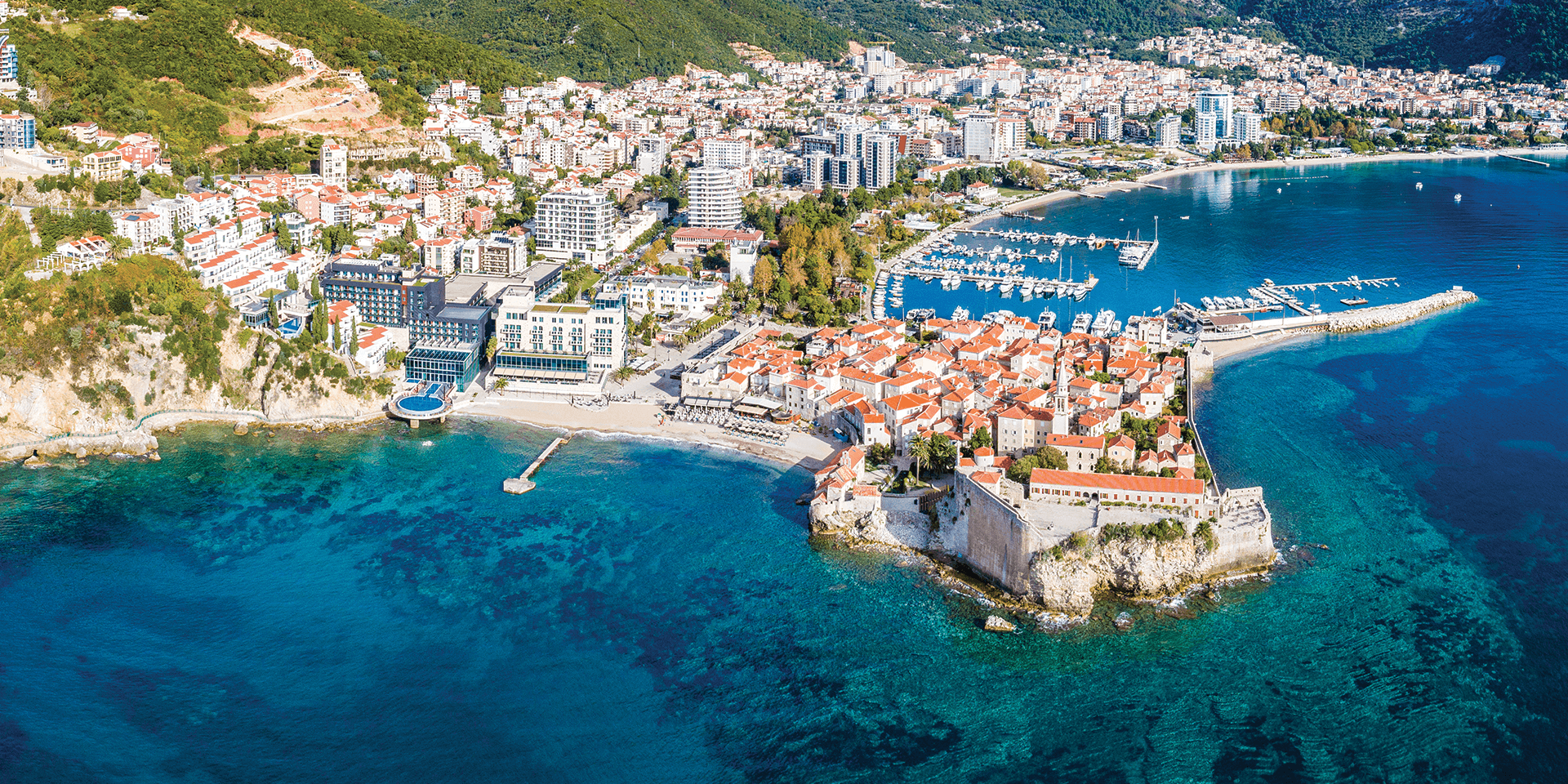
Budva hides more than 2,500 years of history behind its medieval ramparts — from the Citadel overlooking the entire bay to the Austro-Hungarian fortresses on the surrounding hills that guarded access to this part of the Adriatic.
Budva, or as many call it, the "Queen of the Mediterranean", is one of the richest cities in Montenegro, is one of the oldest cities on the Adriatic Sea and offers a rich blend of cultural heritage and natural beauty. The Old Town of Budva is one of the oldest urban settlements on the Adriatic Sea, with a history that dates back more than 2,500 years. It is located on a small peninsula and is surrounded by monumental medieval ramparts, towers and gates, which hide a labyrinth of narrow, cobbled streets and historical monuments.
What else makes the old town recognizable is the Citadel or another name "Fortress Kaštel" is a historic imperial fortress located on the highest point of the southern part of the Old Town in Budva. It is one of the most important cultural and historical monuments on the Montenegrin coast and is a symbol of the defense of this ancient city. It is the most dominant building in the Old Town, whose walls offer a panoramic view of the entire Budva and the island of St. Nicholas. Inside the Citadel Budva there is a luxurious library as well as a museum of ship models that testify to the history of Budva.
Mogren Fortress is another fortress that is a symbol of Budva in this city. A historic military fort located on the slopes of Spas Hill above Budva. It was built by the Austro-Hungarian Monarchy in 1860 to protect the western borders of the city and control access to Budva Bay from the sea. Today, this location is one of the most beautiful and popular viewpoints of the Budva Riviera, which offers a panoramic view of the Old Town, the island of St. Nicholas and Mogren Beach.
Kosmač Fortress Kosmač Fortress is a monumental Austro-Hungarian fortification built in the middle of the 19th century. It is located on the hill of the same name above the village of Brajići, at about 800 meters above sea level, following the main road that connects Budva and Cetinje. It was the southernmost fortress of the Austro-Hungarian Empire and served as a key border guard towards the then independent Montenegro. The fortress is a prime example of military architecture of its time. It was built in stages between 1841 and 1850. Due to its enormous strategic importance, the fortress was personally visited in 1875 by the Austro-Hungarian Emperor Franz Joseph I. Today, this building, although declared a cultural asset of national importance, is in a very bad and dilapidated condition, but still attracts visitors due to its fascinating history and spectacular panoramic view of the Budva Riviera. Đurđevac Fortress
This is the oldest among the surrounding hill fortifications, dating back to the 15th century (during the reign of the Crnojević dynasty). It served as a medieval military stronghold. Access to this fortress is difficult because it is located northwest of the Old Town of Budva in the Grbalj district. It was built by the then ruler of Zeta, Stefan Crnojević in the first half of the 15th century.