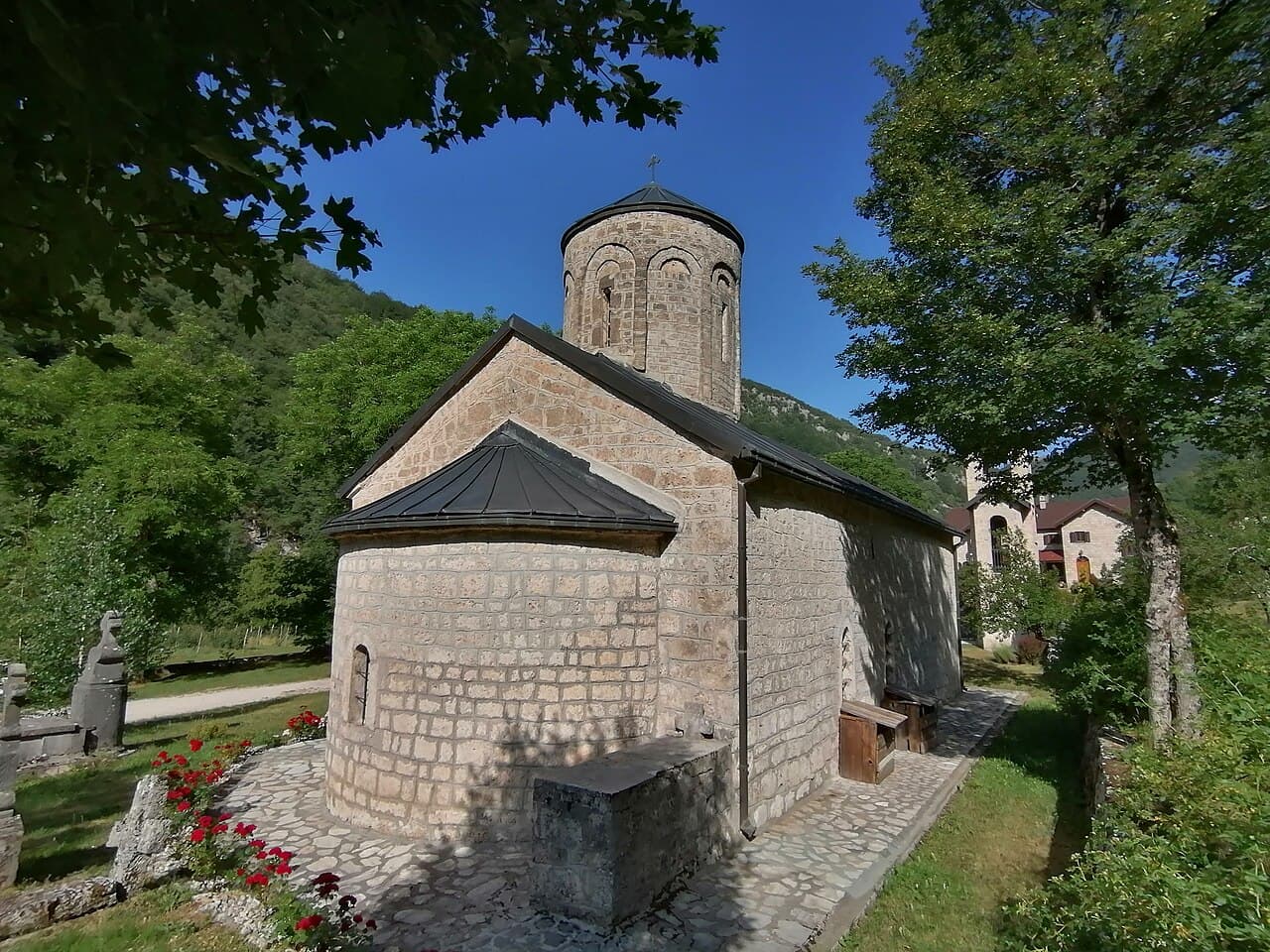
Religious buildings of the municipality of Šavnik are an extremely important segment of the cultural, historical and spiritual identity of the Durmitor region. Located in the valleys of the rivers Bukovica, Bijela, Komarnica and their tributaries, they testify to the centuries-old continuity of the Orthodox tradition, which developed in conditions of mountain isolation, but also of a strong spiritual connection of the local population. The sacral architecture of this area developed in the range from the Middle Ages to the 19th century, with the monasteries of Podmalinsko and Bijela standing out, as the most important spiritual and cultural centers of the municipality.
- Podmalinsko Monastery "one of the oldest spiritual centers of northern Montenegro" Podmalinsko Monastery is located in the village of Tušina, on the right bank of the Bukovica River. According to historical and scientific data, its foundation dates back to around 1252, during the reign of the Nemanjić dynasty, which ranks it among the oldest monastery complexes in this part of the Balkans. The monastery church is dedicated to St. Michael the Archangel and is a typical example of medieval single-nave sacral architecture. It is built of local stone – speleothem, a material characteristic of the Bukovica valley, which allows for easy shaping, but also long-term stability of the building. Architecturally, the building is characterized by: With a simple rectangular basis, With a semicircular apse, With a barrel vault, Modest but harmonious proportions. Throughout history, the monastery has been restored several times – especially at the beginning of the 20th century and the beginning of the 21st century, when it was significantly restored. A special cultural value is also the fact that in 1870 one of the first schools in Drobnjak was opened in the monastery, which gives it educational significance.
- Bijela Monastery "The Spiritual Point of Continuity of the White Valley" The Bijela Monastery is located in the village of the same name, in the naturally enclosed valley of the Bijela River. Historical sources place the church of St. George within this complex in the 17th century (with a tradition dating back to the time of St. John Vladimir), while significant renovations were carried out during the 18th and 19th centuries, which confirms the continuity of its religious life. The church within the monastery belongs to the type of single-nave Orthodox churches of modest dimensions, built of local stone, with emphasized functionality and complete integration into the mountain landscape. Its architectural value is reflected in its harmony with nature, simplicity of form and long-term role as the spiritual center of the local community. VILLAGE CHURCHES OF THE MUNICIPALITY OF SAVNIK
- Church of St. George in Savnik "Parish Sanctuary in the Urban Center of the Municipality" The church of St. George (George) is located in the city center of Savnik and is the central parish church of this town. It was built in 1902, at a time when Šavnik began to develop more strongly as the administrative center of Drobnjak. It was built of finely carved stone, as a single-nave building with a recognizable bell tower on a distaff. Its modest architecture with minimal decorative elements is typical of the sacral buildings of this area from the beginning of the 20th century, reflecting the spirit and aesthetic achievements of Montenegrin state and church architecture of that time.
- Church of St. Petka in Tušina "The Stone Guardian of the People's Gathering in the Bukovica Valley" The church of St. Petka is located in the historic village of Tusina and serves as a village parish sanctuary of this area. Its present forms and structure are the result of multi-phase renovations and construction interventions during the 19th and 20th centuries. Architecturally, it belongs to the type of modest rural single-nave churches made of stone, with a simple spatial organization and a functional interior that is completely subordinated to the needs of the local population during major holidays and village assemblies.
- Church of St. John the Baptist "An Authentic Example of Rural Sacral Architecture of the 19th Century" The church in the village of Mljetičak was built in 1884, which makes it one of the precisely dated sacral buildings in the municipality of Savnik. It was built of hewn local stone, with a rectangular base and a modest architectural solution, characteristic of rural churches of that period.
- Church of St. Nicholas
"The simplicity of mountain tradition" The church of St. Nicholas in the village of Kosorići was built in 1869. It is one of the oldest parishes in the city. The architecture is typically rural: Stone construction, A simple rectangular base, Small window openings, Functional interior. 7. Church of St. George in Petnjica "Spiritual Continuity of the 18th–19th Centuries" The church in Petnjica dates from the 18th to 19th centuries, with several phases of restoration. It was built in the spirit of traditional Durmitor sacral architecture, made of local stone, with modest dimensions and functional design. This shrine dedicated to St. George has exceptional historical significance because it is inextricably linked to the genealogy and ancestors of the great reformer of the language, Vuk Stefanovic Karadzic. CONCLUSION The religious buildings of the municipality of Savnik, from the medieval Podmalinsko Monastery (around 1252), through the Bijela Monastery (17th century), to the village churches from the 19th century, form a unique and continuous sacral whole. Their architecture reflects a blend of modesty, functionality and adaptation to the mountain environment, while their historical significance lies in the long continuity of the spiritual life and cultural identity of the local population. Today, these objects represent not only religious places, but also authentic cultural and historical monuments that testify to the persistence of tradition in one of the most difficult, but also the most authentic mountain areas of Montenegro.