The Municipality of Danilovgrad is an area of rich and deep spiritual, cultural and historical heritage, located in the heart of Montenegro, at the natural crossroads between Podgorica and Nikšić. Although it is a territory that is today associated with the younger city center, the Bjelopavlić area has functioned throughout the centuries as one of the most important spiritual centers and impenetrable bastions of Orthodoxy in the Balkans. This is most vividly evidenced by the monumental monastery complexes and ancient churches that have been preserved despite the stormy historical winds. These shrines represent much more than a place of prayer; They are the centuries-old guardians of folk memory, literacy, superior architectural skill and vivid art. With their fascinating location, embedded in rugged mountain cliffs or hidden in tame plain oases, these points of spirituality today represent global pilgrimage centers that attract believers, tourists and researchers from all over the world.
-
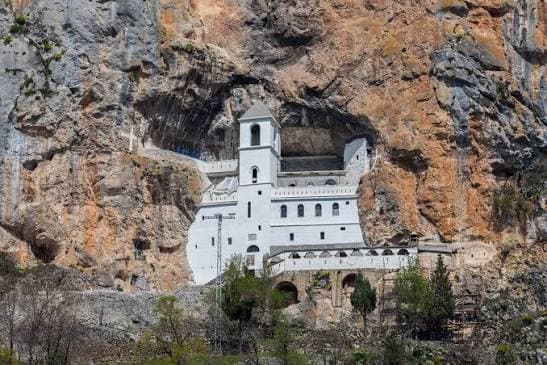
Ostrog Monastery – A miracle of architecture and a cosmic sanctuary in the rock The Ostrog Monastery is undoubtedly one of the most important, exceptional and most visited Orthodox shrines in all of Europe. Located high in the vertical, rugged rock of the mountain Ostroše greda, at almost 900 meters above sea level, this monastery with its incredible location leaves every visitor breathless, acting as if it were the work of a divine, not a human hand. The sanctuary was founded in the 17th century by St. Basil of Ostrog (Jovanović), Metropolitan of Zahumlje and Skadar, whose miraculous and incorruptible relics are still kept in the small cave church of the Upper Monastery. The complex is divided into the Lower Monastery, with the Church of the Holy Trinity, and the Upper Monastery, which is literally carved into the mountain bowels. Inside the Upper Monastery there are two miniature cave churches: the Church of the Presentation of the Most Holy Mother of God (where the Saint rests) and the Church of the Holy Cross, which are adorned with priceless frescoes from 1667, the work of the famous zograph Radul, adapted to the natural shape of the living rock. Ostrog is a unique planetary phenomenon: a place of pilgrimage where hundreds of thousands of people of all world religions and nations come in continuous columns, walking barefoot along a steep path three kilometers long, seeking and finding comfort, healing and spiritual peace before the life of the Miracle Worker.
-
Ždrebaonik Monastery – Nemanjić oasis and home of St. Arsenije Located on the right bank of the Zeta River, in a gentle and quiet plain not far from the center of Danilovgrad, Ždrebaonik Monastery is one of the most important and most active women's monasteries in Montenegro. Folk legend and historical sources link the origin of this sanctuary to the glorious Nemanjić dynasty, that is, to the founding of King Stefan, son of Prince Vulcan, from the 13th century, while today's single-nave church dedicated to St. Archangel Michael was built and renovated on the old foundations in 1818. In addition to its exceptional historical role, the Foal has an invaluable theological significance because it houses the holy and miraculous relics of St. Arsenije of Sremac, the successor of St. Sava on the throne of Serbian archbishops, in a solemn statue in front of the iconostasis. The monastery complex exudes unusual serenity, and its beauty is complemented by impeccably decorated dormitories, a sister's icon-painting workshop, a rich library and a spacious, blooming courtyard. Ždrebaonik has been the gathering place of Bjelopavlić for centuries and an unavoidable stop for all pilgrims who visit the great Montenegrin shrines.
-
Piperska Cell Monastery – Hidden prayer silence above Sušica On the very border of the hills of Bjelopavlić and Piper, rising proudly on a stone cliff above the confluence of the Sušica and Zeta rivers, there is a monastery Celic Piperska. This ancient spiritual center was founded in the first half of the 17th century (around 1637) by St. Stephen of Piper, an ascetic who, before coming to this region, was silent in the monastery of Morača and Tvrdoš. Throughout the centuries of Ottoman slavery, the Piperska Cell was not only a place of incessant prayer, but also a key literate, cultural and educational center of this region, where sacred books were copied and fateful uprising decisions were made. In the monastery Church of the Nativity of the Most Holy Mother of God, the relics of Venerable Stefan are kept, which the faithful people kiss and respect as a source of healing. Today, it is an austere and quiet female monastery that captivates with its modest architecture, the mystical atmosphere of a true hermit scythian and the untouched nature that isolates it from the modern noise and bustle.
-
Church of St. Theclus – Cathedral Sanctuary and Historical Landmark of the City The Church of St. Thecla occupies a special, honorable place in the hearts of the inhabitants of Danilovgrad and represents an inseparable part of the urban and spiritual physiognomy of the city itself. This historic place of worship, located on a dominant hill above the Danilovgrad bazaar, is characterized by traditional, reduced and elegant architecture with a recognizable bell tower, which is typical for old Montenegrin sacral buildings. Throughout history, the church has been the main cult and conciliar place around which the Orthodox people of Bjelopavlić gathered during fateful historical turning points and major holidays. Its spiritual prestige is further founded by the fact that the holy hand (part of the relics) of the Holy Protomartyr Thecle, an equal-apostolic saint from the early Christian period, is kept in it with great devotion. The peaceful and sublime atmosphere of the church yard offers a beautiful view of the city center, symbolizing the role of St. Thecla as the spiritual protector of Danilovgrad. Conclusion The sacral topography of Danilovgrad is an invaluable crown of Montenegrin cultural and historical heritage. From the planetary miracle of Ostrog, which defies the laws of gravity carved into the rugged rock of Ostrog, through the imperial Foal and the hermitage Cell of Piper, all the way to the city's patron saint, the Church of St. Thekla — each of these temples testifies to unwavering faith, sacrifice and survival through the ages. The combination of deep Christian spirituality, top-notch architecture and dramatic natural beauty makes the Zeta Valley a unique spiritual transversal of the Balkans, and Danilovgrad a sacred and unavoidable destination for anyone who wants to touch the authentic roots and eternal soul of Montenegro.