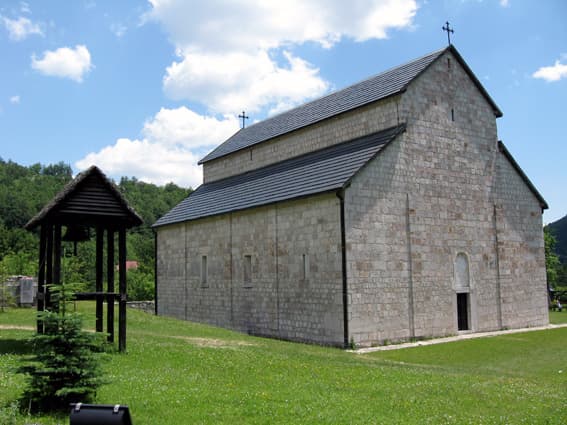
The municipality of Plužine, although mountainous and sparsely populated, has a rich religious heritage that is mainly based on the Orthodox tradition. Over the centuries, monasteries, churches and temples have been built in this area, which played an important role in the spiritual and social life of the population. Most of the buildings date back to the Middle Ages or were later restored, and today they represent an important part of the cultural identity of Piva.
Piva Monastery (Assumption of the Blessed Virgin Mary) Piva Monastery is the most important religious building in the municipality of Plužine. It was built between 1573 and 1586, and was erected by Metropolitan Savatije Sokolović. It is dedicated to the Assumption of the Blessed Virgin Mary. The most special thing in its history is that due to the construction of the hydroelectric power plant and the creation of Piva Lake, a decision was made not to sink the monastery, but to preserve it. Therefore, in the second half of the 20th century, the monastery was completely moved stone by stone to a new location. Each part is carefully disassembled and reassembled, in order to preserve its original appearance and value. Inside the monastery there are old frescoes, icons and a rich treasury. Special mention is made of manuscripts and church objects of great historical value. The monastery has been renovated several times throughout history, but it has always remained the spiritual center of Piva and one of the most important monuments of Orthodox culture in this part of the Balkans.
Zagrađe Monastery (Saint John the Baptist) Zagrađe Monastery is located above Šćepan Polje and originates from the 15th century, with later renovations. It is dedicated to Saint John the Baptist and is located in an area that was important in the Middle Ages, close to fortified towns and old trade routes. Throughout history, it has been demolished and rebuilt several times, but it has retained its spiritual significance. Today it represents an important monument of early monastic life in the Piva area and a reminder of the medieval history of this region.
Church of Saint John The Church of St. John the Baptist in Plužine is located in the town itself and is the main parish church of this area. It was built in the second half of the 20th century, after the new settlement of Plužine was formed on a higher location due to the construction of a hydroelectric power plant and the creation of Lake Piva. This church has a special significance because it represents the continuation of the religious life of the population that had to move from the old Piva valley. That is why it is considered an important symbol of the continuity of tradition and community. Church of St. Makarij Sokolović The Church of St. Makarij Sokolović in Plužine is a modern temple whose construction began in 2016. It is dedicated to Patriarch Makarij Sokolović, one of the most important figures in the restoration of the Patriarchate of Peć in the 16th century. The temple has symbolic significance because it connects contemporary religious life with the historical legacy of the Sokolović family, which had a great influence on this part of the Balkans. Today it is an important place of worship and gathering of believers.
Church of Saint Sava The Church of St. Sava in the village of Orah is an older village temple. The exact year of construction is not known, but it is believed to originate from the 19th century or from an earlier period that was later renovated. It is dedicated to Saint Sava and has great importance for the local population, especially as a gathering place during holidays.
Church of Saint Nicholas Churches dedicated to Saint Nicholas are located in several places in the municipality of Plužine, mostly in rural areas. Saint Nicholas is a highly respected saint in the Orthodox tradition, who is considered the protector of family, travelers and home. Most of these churches originate from the 19th century or from older foundations that were later restored, so the exact date of construction often cannot be precisely determined. In mountainous conditions, Piva churches have been often rebuilt throughout history due to weather and difficult living conditions. These churches were an important gathering place for the local population, where holidays, liturgies and village gatherings were held. Although modest, they had great importance for the spiritual and social life of the village.
Church of Saints Peter and Paul The Church of the Holy Apostles Peter and Paul is located in Crkvički Polje and originates from the 19th or the beginning of the 20th century, with the possibility that there were older foundations. It played an important role in gathering the population of the surrounding villages and is part of the broader Orthodox tradition of this region.
Church of Saint George The Church of St. George in the village of Trsa originates from the 19th century or an earlier renovated period. It is dedicated to Saint George, who is considered a patron saint and a symbol of strength and courage. This church was an important meeting place for mountain inhabitants
Other village churches On the territory of the municipality of Plužine there are a large number of smaller churches in the villages of Stabna, Nedajno, Pišče, Boričje, Bezuje and other settlements. Most of these churches were built between the 17th and 19th centuries, often on older foundations. Although they are of simple construction, they played a big role in the life of the local population because they were the center of religious and social gatherings.
The religious buildings of the municipality of Plužine represent a combination of old tradition and modern times. The Piva Monastery is of greatest importance, while the network of smaller churches shows the deep roots of the Orthodox tradition in this mountainous region. Together, they form an important part of the cultural and spiritual identity of Piva and testify to the continuity of life through the ages.