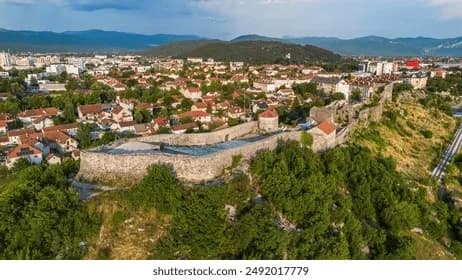
Nikšić, territorially the largest municipality in Montenegro, is a city with an extraordinarily rich cultural and historical heritage. Located in the spacious Nikšić field, this area has been an important crossroads since ancient times due to its geographical position. The story of its survival, defense and development is best preserved by the monumental walls of the Onogošt fortress, better known as the Nikšić Wall, which has stood for centuries as a symbol of the insubordination of this region.
Onogošt Fortress (Wall) – Witness to the change of empires On a steep rocky elevation, which rises about 25 meters above the plain of the Nikšić field, the walls of the Onogošt fortress, popularly known as the Wall, stand proudly. This monumental fortification, 214 meters long, is a true historical textbook in stone that bears witness to the succession of different conquerors over the centuries. The historical layers of the Walls developed chronologically: Roman and Gothic period: It is believed that the fortification was created as early as the 4th century as a Roman military castrum of Anderva (Anderba). In the 5th century, with the arrival of the Goths, the fortress was rebuilt and named Anagastum (after the Gothic commander Anagast), from which the Slavic name Onogošt was later derived. Ottoman Empire: At the beginning of the 18th century, with the arrival of the Turks, Bedem underwent a radical reconstruction and became their key military stronghold in the interior of Montenegro. The fortress was then divided into the Upper Town (Kastel) with a pentagonal three-story tower in the south and an octagonal tower in the north, and the Lower Town, which was surrounded by a system of five towers. A historical turning point occurred in September 1877, when the Montenegrin army under the leadership of Prince Nikola I Petrović successfully freed Nikšić from Ottoman rule after fierce battles, thus the city began its modern, European era. Revitalization and modern life of walls Today, the space inside the walls has been completely revitalized and adapted to the modern social life of the city. A beautiful summer stage was built on the fortress, which offers a panoramic view of the entire Nikšić field and the city districts built according to the plan of Dr. Josip Slade. This iconic stage has become the epicenter of the alternative scene of Montenegro and the home of the famous Bedem Fest. This unique music festival gathers regional rock and alternative artists every year within the ancient walls, transforming the old Turkish stronghold into a space of fusion of history, art and urban energy. A walk along the ramparts provides the perfect opportunity to feel the authentic spirit of Nikšić - a city that built its recognizable cultural identity on the foundations of old battles.