The oldest written sources that illuminate the wider area of today's Tuzi date back to the golden age of Serbian medieval literacy. The toponymy and early forms of organization of this area are mentioned as early as 1222 in the charter of King Stefan the First-Crowned to the monastery of Žiča. A century and a half later, in the famous Decani chrysovulje of King Stefan of Decani from 1330, the katun Lješ Tuzi is explicitly recorded, which is an invaluable testimony to this area as part of the wider Arbanasi cattle and tribal area. During the Middle Ages, the social dynamics of this area were completely subordinated to the katun and early tribal systems. The communities had a nomadic and semi-nomadic character, moving seasonally between the rich pastures of the plains during the winter and the mountainous regions of Malesia during the summer months. Life took place in dispersed, open rural settlements and temporary katuns, without the need to erect permanent city walls or urban fortifications within the settlements themselves. After the fall of Shkodra and the wider region to Ottoman rule at the end of the 15th century, this continuity of life took on a new administrative form. In the extensive Ottoman defter (census) from 1485, households and permanent settlements in this area are precisely recorded, which proves that the change of empire did not break the thread of settlement in this fertile and strategically important area.
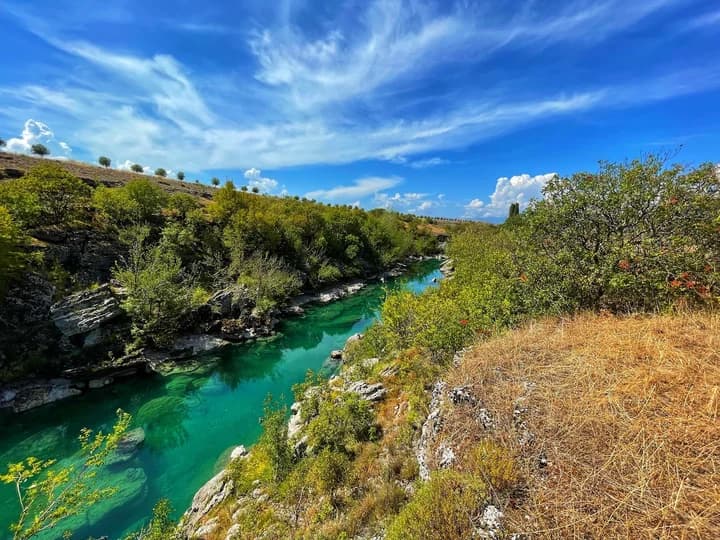
The Ottoman Era: The Development of Open Trading Settlements and the Rise of Military Fortifications During the long period of Ottoman rule, the residential, artisanal and commercial core of Tuzi developed in the lowlands as an open-type settlement, deeply rooted in the traditional tribal division of Malaysia. However, due to the exceptional geopolitical importance of this border zone, the Ottomans based their defensive strategy on controlling the surrounding heights. Just above the settlement itself, a powerful military fortress was built on the Dečić hill, which with its garrison dominated this entire part of the Zeta plain and played a key role in later historical conflicts (such as the Malisor Uprising in 1911). While military life was isolated on fortified elevations such as Dečić and nearby Šipčanik, a specific type of Balkan-Oriental open settlement was formed in the valley itself and on the gentle slopes. Instead of the city walls, the landscape of Tuzi was defined by: Developed trade routes with road hans that connected Podgorica and Skadar, Monumental sacral buildings (Catholic churches, Orthodox churches and mosques) that become centers of literacy and gathering, Traditional family households and towers built of local carved stone, adapted for both housing and defense, The formation of local markets that became points of economic exchange between the hills and the plains. This period brought an intense interpenetration of cultures, languages and religions, shaping Malaysia into a single anthropogeographical entity. The Modern Age: Administrative Rise and Transformation into a Municipal Center The modern development of Tuzi gained a strong momentum during the 20th century, when the settlement, thanks to its position on the international main and railway route between Podgorica and Shkodra, profiled itself as a key economic and administrative center of this part of Montenegro. A historical turning point in the modern history of the city occurred in 2018, when Tuzi received the status of an independent municipality, which rounded off their centuries-old territorial and social identity. With the acquisition of the status of a municipal center, an intensive process of urbanization has been initiated. Modern public institutions, educational centers, cultural facilities and modern infrastructure have been built. Nevertheless, the architects of modern Tuzi have managed to strike a balance: despite urban development, the city has maintained a strong connection with its traditional ambience, avoiding aggressive industrialization and retaining the charm of an open, hospitable and green plain center. Anthropological and archaeological substrate: Malësia as a living museum of tradition The cultural code of Tuzi and the wider region of Malesia is deeply imprinted in the centuries-old heritage of tribal life, highlander pride and unbreakable connection with the rugged but majestic massif of Prokletije. This space does not speak through the cold walls of abandoned fortresses, but through a living, tangible tradition that has been passed down from generation to generation. The key elements of cultural identity are: Traditional costume: Led by the famous Jubleta (Xhubleta) – one of the oldest types of folk costume in the Balkans, whose ornaments hide ancient Mediterranean symbols, Epic and Oral Literature: A Rich Legacy of Heroic Poems, Legends, and Historical Tales That Are Still Cherished and Remembered Today Customary law and ethics: A deep respect for the word (anger), traditional hospitality and solidarity among communities. Archaeological sites: Multi-layered traces of old rural necropolises, tumulus, tombstones and early Christian churches scattered throughout Malaysia. In addition to the rich anthropological heritage, the area of the municipality also includes spectacular natural units, such as the wild canyon of the river Cijevna (Cem), mountain passes and authentic villages where the original rhythm of life and the old architecture of the karst are still recognized. Conclusion The Tuzi do not possess medieval fortresses or preserved "old towns", but their historical significance lies in their long continuity of life, cultural diversity and strategic location between the mountain and the plain. From the medieval katuns of the 13th and 14th centuries, through the Ottoman period, to the present day, this area has been continuously inhabited and shaped by human activity. That is why Tuzi today is not viewed through the architecture of the fortification, but through a layered history, cultural identity and landscape in which the past and present naturally intertwine.