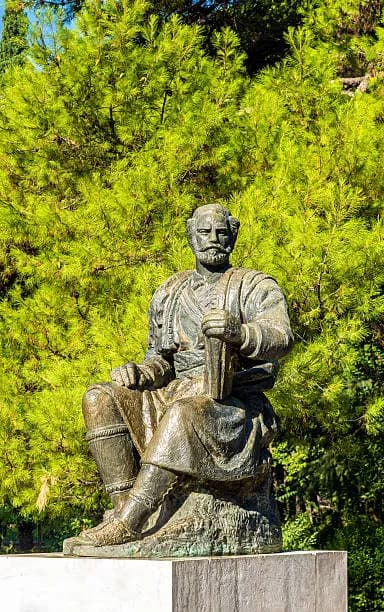
Cetinje, the historical capital of Montenegro, is one of the most special cities in the Balkans, a place where the history, culture and identity of the country, which has lasted for more than five centuries, meet in a small area. Founded in 1482 by Ivan Crnojević, Cetinje was from the very beginning the political and spiritual center of Montenegro, but also the city where its national tradition was shaped.
What makes Cetinje unique is the exceptional concentration of monuments, sculptures and memorials that are found almost at every turn. Instead of classic urban squares full of modern installations, here, through monuments, the memory of rulers, poets, warriors and important historical events that shaped Montenegrin's past is preserved. A walk in Cetinje is actually a journey through time, from the medieval Crnojević dynasty, through the magnificent Petrović era, all the way to modern times. Each monument has its own story, and together they form a unique "memory map" of the city, which is rightly called an open-air museum. That is why Cetinje is not only a historical capital, but also a living cultural destination that offers visitors an authentic experience of the Montenegrin past through art, architecture and memorial symbols. Monument to Ivan Crnojević The monument to Ivan Crnojević occupies a special place in the memorial topography of Cetinje because it refers to the person who founded the capital of Montenegro itself. Ivan Crnojević, the ruler of Zeta in the second half of the 15th century, made a decision that was of decisive importance for the further historical development of the area. In 1482, he founded Cetinje as the new capital, withdrawing from Žabljak Crnojević under the pressure of Ottoman expansion. The monumental interpretation of his personality is not only a tribute to a ruler, but symbolically marks the beginning of the institutional life of Montenegro in Cetinje. In a historical sense, this monument represents the continuity of statehood that goes back to the late Middle Ages, when the core of the future Montenegrin political and cultural tradition was formed. His role in the collective memory is extremely strong, because his image shows the idea of survival and adaptation in the conditions of great historical pressures in the Balkans. Monument to Peter II Petrović Njegoš The monument to Petar II Petrović Njegoš is one of the most important cultural-memorial symbols not only of Cetinje, but also of Montenegrin history as a whole. Njegoš, who ruled Montenegro in the period from 1830 to 1851, was at the same time a spiritual leader, statesman and one of the most important South Slavic writers. His work "Mountain Wreath" from 1847 goes beyond the literary framework and enters the sphere of national philosophy and historical identity. Precisely because of this, the monument to Njegoš in Cetinje is not only a figurative representation of a historical figure, but a symbol of the spiritual vertical of the Montenegrin people. In the urban and cultural context of Cetinje, Njegoš is the central figure around whom almost the entire memorial culture of the city is organized. His monument stands as an expression of the idea of freedom, statehood and intellectual heritage that shaped Montenegro in the 19th century. Monument to King Nikola I Petrović The monument to King Nikola I Petrović refers to the ruler who reigned the longest in the history of Montenegro and who played a key role in its modernization. His reign, which lasted from 1860 to 1918, was marked by major political, social and diplomatic changes. During his reign, Montenegro was internationally recognized at the Berlin Congress in 1878, while in 1910 it was declared a kingdom. The monument dedicated to King Nikola carries multi-layered symbolism, it represents the end of a historical epoch of the Montenegrin monarchy, but also the period of its greatest international reputation. In a memorial sense, this monument connects Cetinje with the European political context of the 19th and early 20th centuries, when the city became a diplomatic center despite its small size. Hunting villa The Lovcen villa, built in 1939, is one of the most recognizable monuments of Cetinje and a powerful symbol of suffering and memory. This monument was originally dedicated to the Montenegrin volunteers who died in the First World War, especially in the tragedy near Medova in 1916. However, over time its symbolic importance expanded and it became a general place of collective memory of all Montenegrin victims of the wars of the 20th century. The figure of a woman, who dominates the composition, represents an archetype of sadness, but also dignity and lasting memory. In the artistic sense, the Lovcen villa belongs to the modern memorial art of the interwar period, when a specific form of memorial culture dedicated to war victims was developing in the Yugoslav space. Monuments of the National Liberation War (1941 - 1945) The monuments dedicated to the National Liberation War in Cetinje were created in the period immediately after the Second World War, most intensively between 1945 and the 1960s, within the broader memorial policy of socialist Yugoslavia. Their basic function was to mark the suffering of the population, the contribution of the partisan movement and the liberation of the city that took place in 1944. These monuments are not only a political marking of a historical event, but also an attempt to shape a collective memory of war trauma and resistance through public space. In Cetinje, which had an important administrative and symbolic role during the war, the memorialization took on special importance because the city was one of the key centers of the resistance organization in Montenegro. In an artistic sense, the monuments of this period often combine monumentality and symbolism of suffering, whereby the emphasis is placed on the idea of common sacrifice and liberation, rather than on individual heroes. Cetinje memorial ossuary The memorial ossuary in Cetinje is one of the most important memorial facilities dedicated to the victims of the Second World War. It was created in the period after 1945, as part of the system of permanent marking of fallen soldiers and civilians. Its function goes beyond the classical monument form, because it simultaneously represents a tomb and a memorial center. It houses the remains of fighters who died in the fight against fascism, giving the space a strong emotional and symbolic significance. The memorial ossuary is a place of silence and commemoration, but also a space of institutionalized memory, where the continuity of the anti-fascist tradition is maintained through state ceremonies. "His Thought" monument The monument known as "Njegoš's thought" represents a modern artistic interpretation of the philosophical and literary legacy of Petar II Petrović Njegoš. It was created in the second half of the 20th century, in the period when Montenegrin and Yugoslav art developed a tendency towards more abstract and symbolic expression in memorial sculpture. Unlike classical figurative monuments, this monument does not depict a physical figure, but an idea, Njegoš's thought about freedom, struggle and the existential struggle of man. Precisely because of this, this monument has a strong philosophical dimension and is often interpreted as a combination of literature, politics and spirituality. Its value lies in the fact that it does not memorialize an event, but an idea, which makes it one of the most modern forms of monumental art in Cetinje. Busts of historical figures from Cetinje A special layer of the monumental heritage of Cetinje consists of busts of historical, literary and cultural figures, which were mostly erected during the 20th century, especially in the period of socialist Yugoslavia, when there was a pronounced need for institutional shaping of historical memory. Among the most significant busts are those dedicated to Sima Milutinović Sarajlija, Vuk Mandušić, Nikac od Rovina, Ljuba Nenadović and other figures who played a key role in Montenegrin literature, folk tradition and political development. These busts do not function only as individual portraits, but as part of the unique urban narrative of Cetinje, where the continuity of cultural identity is shown through the public space. They are often located in parks and next to important institutions, which further emphasizes their educational and symbolic function. "Relief of Montenegro." The relief of Montenegro on Cetinje represents a unique combination of artistic and educational-memorial expression, created in the 20th century as part of the need to visually show the territorial, historical and cultural development of the country. This relief is not only a cartographic representation of space, but also a symbol of state identity, because it unites the idea of continuity of Montenegro from medieval Zeta to the modern state. Its value is reflected in the fact that it allows the observer to see the geographical and historical flows that shaped the Montenegrin space in one unit. As such, the relief has both a didactic and a memorial function, as it connects space and history into a unique narrative of statehood. Government House, Zeta House and Blue Palace as monumental units Although they are not seen as classical monuments in the form of sculptures, the Government House, the Zeta House and the Blue Palace have the status of extremely important cultural and historical monuments of Cetinje, because they represent the institutional framework of Montenegrin statehood. The Government House, built in 1910, was created in the period when Montenegro transitioned from a principality to a kingdom, and is the seat of the state administration of the Kingdom of Montenegro. Its monumental architecture testifies to the ambition of the then state to present itself as part of the European political space. Zetski dom, built in 1888, is the first Montenegrin theater and one of the most important cultural buildings in Cetinje. Its importance goes beyond architecture, because it symbolizes the development of theater art and cultural life in Montenegro at the end of the 19th century. The Blue Palace, built in 1895, was the residence of the heir to the throne, Danilo Petrović. Today it has a state function, but at the same time it represents the continuity of the monarchical and state tradition of Montenegro. Together, these three buildings form a kind of "institutional monument complex" of Cetinje. Orlov krs - the grave of Bishop Danilo Orlov karst represents one of the most important memorial sites in Cetinje, because it is where the grave of Bishop Danilo Petrović, one of the key rulers of the early Montenegrin state organization, is located. Bishop Danilo, who worked in the 17th and early 18th centuries, is considered the founder of the political structure of the Petrović dynasty. This place has a strong symbolism because it connects the natural space with the national memory. Orlov karst is not only a burial place, but also a symbol of the beginning of institutional Montenegro, where the continuity of power and resistance is affirmed through historical memory. Memorial plaques, memorial spaces and diplomatic buildings A special segment of Cetinje's monumental heritage consists of numerous memorial plaques and memorial spaces scattered around the city, which mark important historical events, personalities and periods. These plaques were often placed in the second half of the 20th century, as part of the systematic marking of the history of Montenegro. This group also includes the buildings of former diplomatic missions of great powers, such as Russia, France, Italy, Austria and Great Britain, which testify to the fact that Cetinje was an internationally recognized diplomatic center in the late 19th and early 20th centuries. These buildings have the status of cultural monuments because they represent a unique phenomenon of a small European capital with a developed diplomatic corps. CONCLUSION The monumental heritage of Cetinje represents a layered and unique entity that encompasses more than five centuries of historical development. From the founding of the city in 1482, through the rulers Ivan Crnojević, Njegoš and King Nikola, until the wars of the 20th century and modern memorial interpretations, Cetinje remains a place where history is not only remembered, but also actively shaped through monuments. These monuments are not isolated objects, but part of a unique urban and cultural system in which statehood, art, religion and collective memory are intertwined. Precisely because of this, Cetinje is rightly considered a "city of memory", where each monument represents a fragment of the broader historical story of Montenegro.