Podgorica, the capital of Montenegro, is a city where different eras meet in one space — from ancient Duklja and medieval Ribnica, through the Ottoman legacy and the Yugoslav period, to the modern European urban center. Located at the mouth of the Ribnica River in Morač, Podgorica has been a natural crossroads of roads, cultures and civilizations throughout history. Today, this city is recognizable not only as the administrative and economic center of the country, but also as an area of rich cultural and monumental heritage. Its streets, parks and riverbanks preserve monuments that tell the stories of important historical figures, war events, art and international relations. A walk through Podgorica is actually a journey through time — from the Roman traces of Duklja, through the rulers of the Petrović-Njegoš dynasty, to modern monuments dedicated to writers, artists and historical figures from Montenegro and the world. This guide takes you through the most significant monuments of Podgorica, revealing their history, symbolism and place in the city's identity.
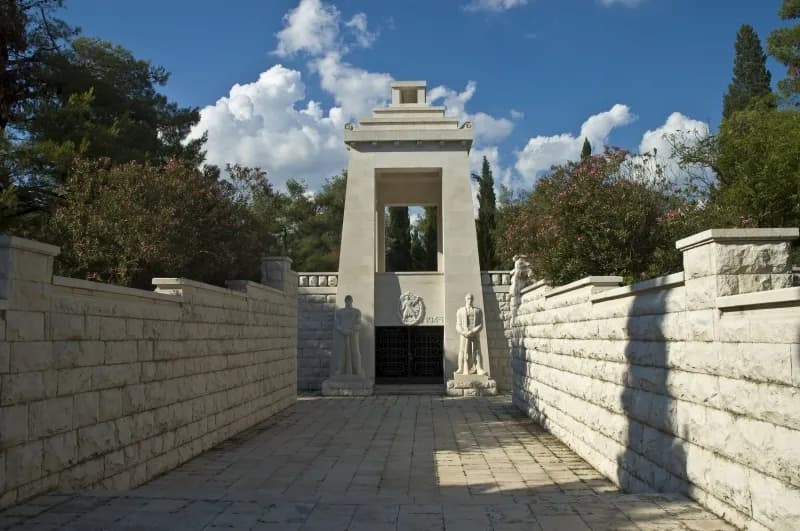
Monument to innocent victims The monument to the innocent victims of Podgorica was erected in 1994 in the city center, according to the project of the architect Vasilij Knežević. It is dedicated to the civilian victims of the wars of the 20th century, especially those who died during the Allied bombing of Podgorica in 1943-1944. year, when the city was almost completely destroyed. The special historical and memorial value of this monument is given by the fact that part of the unexploded aerial bomb found in Podgorica was incorporated into its construction. Thus, the monument becomes a direct material evidence of war destruction and a permanent reminder of the suffering of civilians. Monument "Montenegro" The "Crnogorac" monument is the work of the famous sculptor Drago Đurović, created in the second half of the 20th century, and is located in the urban part of Podgorica. This monument does not represent a specific historical figure, but an idealized image of the Montenegrin man through the ages. The monumental figure in national costume symbolizes bravery, heroism, the spirit of freedom and the age-old struggle for survival, representing the collective identity and continuity of the Montenegrin people. Monument to Franz Prešern The monument to Franz Prešern is located in Moskovska Street, in the park named after him, and was unveiled in 2007. It is dedicated to the greatest Slovenian poet Franz Prešeren (1800–1849), the author of the verses of the Slovenian national anthem and one of the key creators of South Slavic and European romantic literature. The monument is a symbol of the strong cultural cooperation between Montenegro and Slovenia and represents the permanent connection between the two peoples through the literary tradition. Monument to Alexander Pushkin and Natalia Goncharova The monument was erected in 2002 on the banks of the Morača River, near the Blaž Jovanović Bridge, as a gift from the Russian Federation and the city of Moscow to Podgorica. The work depicts the great Russian poet Alexander Pushkin (1799–1837), the founder of modern Russian literature, together with his wife Natalia Goncharova. The monument symbolizes the cultural and historical ties between Montenegro and Russia, as well as the universal value of poetry and art. Monument to Vladimir Visocki The monument to Vladimir Vysotsky was erected in 2004 next to the Millennium Bridge along the Morača River, also as a gift from the city of Moscow. It is dedicated to the legendary Russian poet, actor and musician Vladimir Vysotsky (1938–1980), whose work was a symbol of freedom, rebellion and human dignity. The sculpture depicts him with a guitar and a palm above the water, which symbolizes his artistic expression and the special affection he had for Montenegro. Monument "Montenegro Oro" The "Montenegro Oro" monument is a contemporary sculptural work inspired by a traditional Montenegrin folk dance. Created in the 21st century, this monument does not mark a specific historical event, but the intangible cultural heritage of Montenegro. "Oro" symbolizes togetherness, collective spirit and cultural tradition, and the sculpture dynamically depicts movement and folk dance as an indispensable part of national identity. Monument to Josip Broz Tito The monument to Josip Broz Tito is located on St. Peter Cetinjski Boulevard and is the work of prominent Yugoslav sculptor Antun Augustinčić. It was created in the second half of the 20th century and is one of the most famous public sculptures in Podgorica. Tito (1892–1980) was the president of the SFRY and the leader of the National Liberation Struggle. The monument recalls the period when Podgorica was called Titograd (1946–1992) and the intensive post-war development and urbanization of the city. Monument to fallen fighters in Gorica The memorial complex on the hill of Gorica was ceremonially unveiled on July 13, 1957, on the Day of the Uprising of the People of Montenegro. The authors of this imposing monument are the architect Vojislav Đokić and the sculptor Drago Đurović. The complex is dedicated to the fighters and victims of the National Liberation War (1941-1945). The remains of 66 national heroes are buried in the crypt of the monument, which makes it one of the most important and significant anti-fascist memorials in the country. Monument to Barutana The Barutana Monument is located in Lješanska nahija and is a memorial complex dedicated to the victims of the Liberation Wars, the Balkan Wars, the First and Second World Wars. It is the author's work of the architect Svetlana Kana Radević. Throughout history, Barutana has been a place of heavy fighting and resistance, and this memorial complex, with its unique architecture, symbolizes the sacrifice of the inhabitants of this region and preserves the collective memory of war events. Monument to Valtazar Bogišić The monument to Valtazar Bogišić was erected in 2002 in front of the Faculty of Law in Podgorica. The authors of the monument are the sculptors Pavle Pejović and Maja Velimirović-Popović. Bogišić (1834–1908) was one of the most important lawyers and codifiers in the Balkans, known for drafting the famous General Property Code for the Principality of Montenegro from 1888. The monument symbolizes the beginnings of the modern legal order, science and institutions in Montenegro. Monument to Ivan Crnojević The monument to Ivan Crnojević is dedicated to the ruler of Zeta from the 15th century and the founder of Cetinje. Ivan Crnojević was remembered in Montenegrin history as the ruler who transferred the political and spiritual center of the country under Lovćen and thereby laid the foundations of modern Montenegrin statehood. The monument in Podgorica symbolizes the continuity of the state-building idea and the formation of the first organized political structure in the Middle Ages. Monuments to Peter I and Peter II Petrović Njegoš The monuments to Peter I and Peter II Petrović Njegoš belong to the most important layer of Montenegrin state, cultural and spiritual history. Although they are presented in Podgorica through separate sculptural units, they form a unique symbolic pillar of the Montenegrin state. Petar I Petrović Njegoš (St. Petar Cetinjski, 1747–1830) was a bishop and statesman who united the Montenegrin and mountain tribes, strengthened the central government and laid the foundations of the modern state by adopting the General Montenegrin and Mountain Code. Petar II Petrović Njegoš (1813–1851) was a bishop, ruler, philosopher and poet. His masterpiece Mountain Garland (1847) represents the pinnacle of South Slavic literature. Njegoš combined statesmanship and spiritual role, leaving an indelible mark on the identity of Montenegro. Monument to King Nikola I Petrović The monument to King Nikola I Petrović is located in the park opposite the Parliament of Montenegro and was erected in 2005. The author of the equestrian sculpture is the sculptor Risto Radmilović. Nicholas I (1841–1921) was the last Montenegrin monarch and one of the longest-lived European rulers of his time. During his half-century rule, Montenegro received international recognition of its independence at the Berlin Congress in 1878, expanded its territory, implemented significant state reforms, and in 1910 was declared a kingdom. Monument to Princess Jelena Petrović of Savoy The monument to Princess Jelena was erected in 2021 in the courtyards of the Kruševac complex, near Petrović Castle. The author of the monument is the sculptor Adin Rastoder. Jelena Petrović (1873–1952), daughter of King Nicholas I, became Queen of Italy by marrying the Italian King Victor Emmanuel III. She was remembered for her self-sacrificing humanitarian work, especially during the First World War and after the devastating earthquake in Messina. The monument symbolizes the fusion of Montenegrin and European history, as well as the noble role of women in historical processes. Monument to Marko Miljanov The monument to Marko Miljanov Popović (1833–1901) is located near the building of the Capital City, and is dedicated to the famous prominent duke from Kuč, warrior and writer. Marko Miljanov became famous in the battles against the Ottoman Empire, but his most lasting contribution remained in the literary work Examples of courage and heroism, in which he gave a permanent definition of the moral code: "Heroism is when I defend myself from others, and courage is when I defend others from myself." The monument represents the foundation of the ethical identity of Montenegro. Conclusion The monuments of Podgorica represent a unique historical mosaic that includes several eras — from medieval statehood, through the enlightening and liberating era of the Petrović-Njegoš dynasty, the Yugoslav period of construction and anti-fascism, all the way to contemporary cultural ties with the world. This monumental heritage does not function only as an aesthetic decoration in the space, but as a living historical document. Each monument in Podgorica represents a precious fragment of the wider story of Montenegro, its long struggle for freedom, rich culture and inseparable European affiliation.