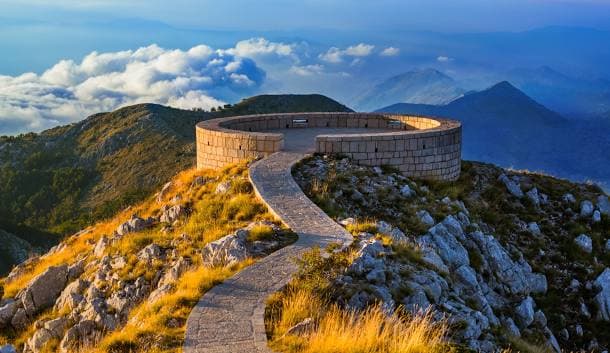
This national park encompasses the central and highest part of the mountain massif of the same name, which rises directly above the Adriatic coast and the Bay of Kotor, representing the historical and geographical pillar of Montenegro. It covers an area of about 6,220 hectares and received the status of a national park in 1952. Although it is entirely located on the territory of the municipality of Cetinje, this area has the status of a national sanctuary and a symbol of freedom for the entire country, primarily because of its priceless cultural and historical heritage.
The absolute symbol and the most recognizable sign of the park is the monumental Njegoš Mausoleum, built according to the project of the famous sculptor Ivan Meštrović on Jezerski vrh, at 1,657 meters above sea level. A specific tunnel carved into the rock with 461 steps leads to this impressive building. From the viewpoint at the top, there is an incredible panoramic view that in clear weather covers almost the entire Montenegro, the Adriatic Sea and Lake Skadar. The Lovćen massif itself is characterized by a distinct karst relief full of pits, abysses and sinkholes, among which the bay of Ivanova korita stands out for its beauty. Located at about 1,200 meters above sea level, Ivanova korita is a popular picnic spot rich in cold mountain water springs.
Due to the specific position and the sudden ascent from the sea to the heights, there is a direct collision of the mild Mediterranean and harsh mountain climate. This natural phenomenon has allowed the development of an extremely rich plant world with over 1,300 species, many of which are endemic and protected. Dense forests of beech and oak in the lower zones slowly alternate with bare karst on the peaks, creating a home for a variety of animals such as wolves, foxes, martens and wild boars, while the sky of Lovćno is dominated by birds of prey such as falcons and eagles. The foot of the mountain and the entire protected area of the municipality of Cetinje are imbued with traditional Montenegrin architecture – old stone houses with guvni, souwid and pedestrian paths that once connected the interior with the coast. On the slopes of the mountain is the famous village of Njeguši, the birthplace of the Petrović-Njegoš dynasty. This village is widely known for its preserved rural architecture and top gastronomic specialties. Traditional Njeguš prosciutto, cheese and mead, which have been prepared and dried for centuries in the specific air of Lovćen, have become a recognizable part of the cultural identity and an unavoidable point for every visitor.