Cetinje is the historical and cultural capital of Montenegro, a city that still carries this role as the main center of Montenegrin heritage, art and spirituality. Although the administrative centers have been relocated today, Cetinje has remained the emotional and identity heart of the country, unavoidable for understanding Montenegro's past. What makes Cetinje an urban and tourist phenomenon is its unique compactness – in the historic center of the city, just a few minutes' walk away, monumental palaces, museums, galleries, churches, historical libraries and former royal embassies are concentrated. A walk through Cetinje is an authentic journey through epochs: from the harsh times of bishop-masters and spiritual resistance, through the golden royal age and European diplomacy of the 19th century, all the way to the modern Montenegrin state.
- National Museum of Montenegro – Umbrella Guardian of the National Treasure The National Museum of Montenegro (NMCG) is the central and most important museum institution in the country. This complex complex brings together several thematic museums that are strategically located in buildings that themselves represent protected monuments of architecture and culture of the highest order. Within this umbrella institution there is a Historical Museum, located in the neo-Renaissance building of the Government House from 1910, which offers a chronological cross-section of the development of the country from prehistory to modern times. In the same building there is an Art Museum, as the richest art treasury in the country, while the Ethnographic Museum has found its place in the architecturally beautiful building of the former Serbian Embassy. The National Museum complex is rounded off by two royal residences turned into exhibition spaces – the King Nikola Museum, located in the former Royal Palace, and the Njegoš Museum, located in the historic Billiards. The Historical Museum Located in the Government House, which once served as the seat of the Montenegrin Parliament, this museum takes visitors through all the key phases of Montenegrin statehood. The exhibition shows in detail the periods of ancient Duklja, medieval Zeta, centuries of struggle under the Petrović-Njegoš dynasty, all the way to the turbulent 20th century and the final restoration of independence. The museum preserves key state documents, charters, originals of old laws, as well as famous war flags from the liberation battles, among which those from the Wolf Work stand out. Art Museum This museum represents the richest art treasury of Montenegro, where works of inestimable value are kept. In addition to the works of the most important Montenegrin modern painters, such as Petar Lubarda, Milo Milunović, Dado Đurić and Branko Filipović Filo, the museum also has exceptional collections of Yugoslav and world art. A special place within this museum is occupied by the Blue Chapel, a space purpose-built to preserve the icon of the Virgin of Philermose. According to tradition, this pan-Christian sanctuary was painted by the Holy Apostle Luke. Over the centuries, the icon has traveled an incredible journey from Jerusalem, through Rhodes, Malta and Russia, and after World War II it found its permanent and safe refuge in Cetinje, attracting pilgrims and art lovers from all over the world. Ethnographic Museum Through the exhibitions in the building of the former Serbian Embassy, the Ethnographic Museum offers an intimate insight into the everyday life of the Montenegrin people through the centuries. Unlike other museums that celebrate rulers and major political events, this space is entirely dedicated to the common man. The rich collections include authentic folk costumes from all parts of Montenegro, which are recognizable by meticulous gold embroidery, traditional tools, old musical instruments, authentic furniture and utility items that vividly describe the interpenetration of different cultural influences in this land.
- Residences and courts of the Petrović-Njegoš dynasty
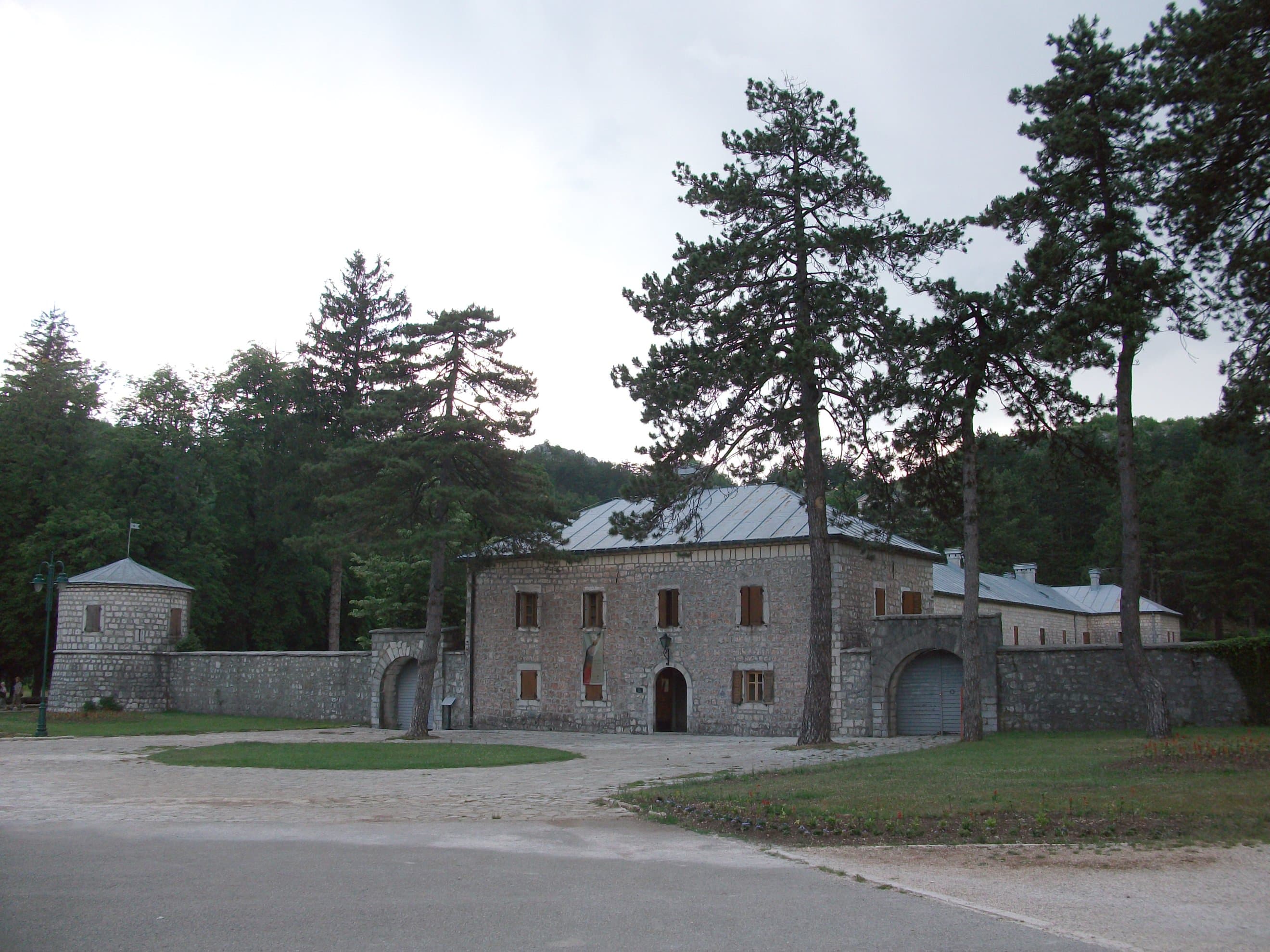
King Nikola's Court (King Nikola Museum) The former residence of the last Montenegrin sovereign, built in 1867, today functions as the most visited museum in Cetinje. The interior of the palace has been largely preserved in its original form, with authentic period furniture that is a blend of oriental influence, Biedermeier and Amphire style. Visitors can tour the royal work cabinets, ceremonial salons, bedrooms, as well as the lavish hall with diplomatic gifts that Montenegro received from European courts. The museum also has a unique collection of Montenegrin and confiscated Turkish weapons from the liberation wars. Njegoš Museum – Billiards Built in 1838 under the direct supervision of Petar II Petrović Njegoš, this fortified residence with four corner towers was the secular center of Montenegro. It was named after the billiard table that Njegoš brought from Vienna, which is still kept in the museum. In addition to Njegoš's personal belongings, weapons and personal library, the original manuscript of the "Mountain Wreath" is kept in Biljarda. In the courtyard of the Billiards there is another great attraction – the monumental Relief of Montenegro, a precise geographical map in stone and concrete made by the Austro-Hungarian army in 1916. Blue Castle – Residence of the President of the State Built in 1895 in the style of a late ampir as the residence of Crown Prince Danilo Petrović Njegoš, this castle attracts attention with its distinctive, vibrant light blue façade and Corinthian columns. Located between two city parks, the castle has changed its purpose frequently throughout history, serving as a royal home, school, and gallery. Today, it serves as the official residence of the President of Montenegro, thus continuing the tradition of Cetinje as an active political and state symbol of the country. 3. Institutions of the performing arts and the written word
Royal Theatre "Zetski dom" Zetski dom is the oldest professional theater in Montenegro and a pillar of Montenegrin performing arts. Its construction began in 1884 according to the project of the famous architect Josip Slade, and the first performance was carried out in 1888. Zetski dom was not only a theater, but also a place where the first public lectures and key cultural gatherings of that time were held. Today, with the status of the Theatre Royal, it offers a superb contemporary and classical repertoire, combining centuries-old tradition with modern European theatrical expression. Public institution Cultural Center of the Capital of Cetinje As a counterpart to historical institutions, the Cultural Center is the main hub of contemporary, everyday artistic life of the citizens of Cetinje. Located in the urban core, the Center organizes film screenings, concerts of alternative and classical music, literary evenings of local authors, forums and exhibitions of young visual artists throughout the year, thus ensuring that Cetinje is not just a silent monument of the past, but a lively, urban and creative city. National Library of Montenegro "Đurđe Crnojević" The National Library is the custodian of the written and printed word in the country. It is located in the architecturally fascinating buildings of the former Italian Embassy (a building with a luxurious park) and the former French Embassy (recognizable by its specific ceramic tile façade). The library preserves priceless treasures: old incunabula, manuscript books from the Crnojević printing house from the 15th century, rare geographical editions, old letters and archival material of crucial importance for Montenegrin historiography. Public Library and Reading Room "Njegoš" Founded in 1868 as the Cetinje Reading Room, this is the oldest public library in Montenegro. Its founder was Prince Nikola, with the intention of literate the people and encourage the cultural upliftment of the young capital. Today, this library is a living cultural center that organizes book promotions, workshops for children and young people, and meetings with prominent writers from the region, preserving the authentic and noble spirit of the Enlightenment in Cetinje. Conclusion Cetinje is a city where history is not locked in museum showcases, but pulsates through facades, cobblestones and parks. Its cultural institutions, theater, palaces and libraries form a unique cultural network that not only documents the past, but actively shapes the contemporary identity of Montenegro. A visit to these institutions provides a unique and complete experience of a country that, despite its turbulent history and constant pressures, has managed to preserve its written word, high art and state continuity.