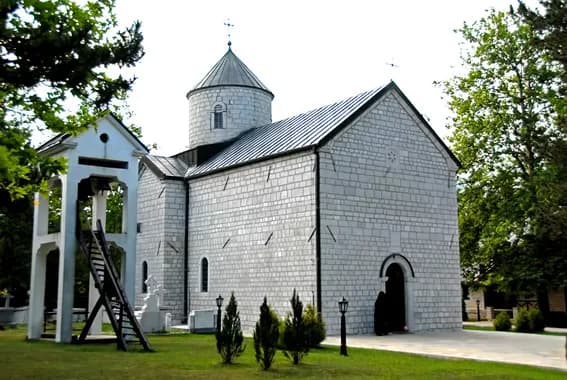
The area of the municipality of Nikšić is a fascinating crossroads of cultures, peoples and religions, which has left a deep and indelible mark in its sacral landscape. Religious buildings belonging to the Orthodox, Islamic and Catholic traditions, located in the city center and its picturesque surroundings, loudly testify to the rich history, architectural diversity and centuries-old cultural coexistence in this area. These temples are not only places of prayer, but also first-class cultural monuments that preserve the story of the transformation of Nikšić from a fortified Ottoman kassaba into a modern European town.
- Orthodox councils and ancient city churches His Eminence Bishop of St. Basil of Ostrog The Cathedral of St. Basil of Ostrog is considered the most recognizable architectural symbol and spiritual center of Nikšić. It was built at the end of the 19th century (construction began in 1895, and the temple was solemnly consecrated in 1900) in honor of Montenegrin and Herzegovinian warriors killed in the liberation wars from 1875 to 1880. The temple was built on the Petrova glavica hill, right next to the monumental King Nicholas Castle (which now houses the Museum), according to the project of the famous Russian architect Mikhail Timofeyevich Preobrazhensky. This monumental building, made in the neo-Byzantine style with elements of Russian sacral architecture, dominates the city's skyline. In front of the temple there is an impressive square, and a luxurious stone staircase leads to the entrance, which gives the whole complex the appearance of a sanctuary-fortress. Church of the Holy Apostles Peter and Paul (Peter's Church) In the immediate vicinity of the Cathedral, at the foot of Peter's Square, there is the Church of the Holy Apostles Peter and Paul, which is known as one of the oldest preserved churches in this area. Its specific, archaic architecture with a single-nave base and low vaults indicates the deep age of the building, which was rebuilt on several occasions throughout the Middle Ages and the Ottoman period. What makes this church archaeologically invaluable is the old cemetery that surrounds it. Around its walls there are monumental medieval tombstones – stone tombstones with unique relief decorations and symbols, which testify to the literacy, art and tribal life of the old Onogoš parish centuries before the arrival of the Ottomans. Church of St. George under Trebjes In the narrower part of the city, located at the foot of the recognizable hill and park-forest of Trebjes, there is the Church of St. George. This church is a cult and historically important place for the people of Nikšić. Surrounded by dense forest and untouched nature, it offers a peaceful oasis for prayer and gathering of believers, and is also an unavoidable stop for recreationists and tourists visiting this protected site. Historically, the area around this church is related to the old cemeteries of the famous Nikšić tribe of Trebješan.
- Historical Orthodox monasteries of the Nikšić region
Monastery Župa Nikšićka (Monastery of St. Luke) Located in the tame and fertile valley of Župa, this active women's monastery dedicated to the Holy Apostle and Evangelist Luke is a jewel of the spiritual life of this region. According to folk legend, the monastery has medieval roots and is associated with the Crnojević dynasty, but over the centuries, due to its prominent position on the hajduk and military trails, it was repeatedly destroyed by Ottoman campaigns. Today's appearance of the monastery church dates back to the 19th century, when it was restored under the patronage of Prince Danilo. Today, the monastery is known for its exemplary sisterhood, icon-painting workshop and carefully decorated, peaceful monastery estate. Kosijerevo Monastery Kosijerevo Monastery is a historically extremely important male monastery dedicated to the Nativity of the Most Holy Virgin. Its historical fate is inextricably linked to the fate of the people on the border of Montenegro and Herzegovina, because for centuries it served as a meeting place for the insurgents, a gathering place for tribes and a cultural center. The monastery survived an unusual construction and engineering endeavor: due to the construction of the hydroaccumulation system and the creation of the artificial Bilećko Lake in the valley of the Trebišnjica River, the entire monastery complex was carefully dismantled in the 1960s, stone by stone, and moved to its current location in the village of Petrovići. The monastery is known for the fact that the relics of St. Arsenije Sremac, the successor of St. Sava, have been kept in it for a long time, and even today it has an extremely valuable treasury of old icons and liturgical books. Monastery Dragovoljići The Dragovoljići Monastery, dedicated to the Savior (Ascension of the Lord), is located in the village of the same name in Nikšić on a mountain plateau above the city. It is known for its authentic ambience of church architecture that blends perfectly with the harsh and beautiful landscape of the Montenegrin karst. This monastery provides an insight into the humble but steadfast ascetic life of monks and is an important spiritual retreat for the population of the surrounding villages and visitors seeking peace outside urban areas. 3. Islamic and Catholic heritage in the urban core
Hadji-Ismail Mosque – Monument of Oriental Culture The Hadji-Ismail Mosque is the only remaining and preserved Islamic religious building in Nikšić. It is located in Grudska mahala and today has the status of a protected cultural monument, and represents the strongest material symbol of multiculturalism and religious tolerance in the city. On its lintel there is an inscription that testifies that the mosque was built in 1804 by Hadži Ismail, a prominent merchant from Nikšić, on the foundations of an older and damaged mosque that was destroyed during the Montenegrin-Russian attacks on the fortified city of Onogošt. It is assumed that the original Islamic building existed on this site as early as the 16th century. The mosque is characterized by a slender, stone minaret and recognizable architecture of Ottoman classicism in the Balkans, and by the decision of the Institute for the Protection of Monuments of Montenegro, it was officially declared a cultural and historical monument in 1952. Catholic Church of Saints Cyril and Methodius ("The Beauty of Nikšić") The Catholic Church of St. Cyril and Methodius is a sacral building located in the narrower part of the city, which has been the center of the Catholic parish in Nikšić for decades. Among the local population and architects, it was rightly given the flattering name "Nikšić Beauty" because of its extremely specific, modern architecture with a pyramidal roof structure that symbolizes mountain peaks and represents one of the most daring solutions of modern sacral architecture of the second half of the 20th century in this region. It was solemnly blessed and put into use in 1986. It is the successor of the original Nikšić Catholic Church, which was built in 1932 (primarily for the needs of experts, engineers and workers of the Catholic faith who worked on the industrialization of Nikšić in the interwar period), and which later had to be demolished due to new urban plans and the expansion of the city boulevards. Conclusion The overall sacral architecture of Nikšić is proof that the history of this city is not one-dimensional. From the neo-Byzantine splendor of the Cathedral and the mysterious tombstones of Peter's Church, through hidden mountain monasteries, to the oriental outlines of the Hadži-Ismail Mosque and the avant-garde pyramid of the Catholic Church – Nikšić preserves a unique religious and cultural mosaic. Today, these buildings are not only tourist attractions, but living witnesses of the interpenetration of different civilizations that have learned to live and last side by side in this area.