Located in the picturesque Plav-Gusinje basin, at the foot of the grandiose, harsh and eternal snow-covered peaks of Prokletije, Gusinje is one of the most fascinating, diverse and authentic cultural environments in Montenegro. This mountain town, located at the crossroads of old caravan roads, at the place where the rivers Vruja and Grnčar create the Ljuča River, has functioned throughout the centuries as a dynamic hub and meeting point of different peoples, languages and religions. This turbulent and rich history has given rise to a spiritual tapestry that is rarely encountered. Although territorially and population-wise, Gusinje stands out for the exceptional concentration and architectural beauty of its Islamic, Orthodox and Catholic sacral buildings. The true uniqueness of this area lies not only in the mere existence of different shrines, but in their unusual urban and human relationship — they proudly stand next to each other, often within the same street. The sound of the call to prayer from the minaret and the ringing echoes from the church towers have not competed here for centuries, but have alternated harmoniously, testifying to the centuries-old coexistence, deep mutual respect and common destiny under the cursed sky.
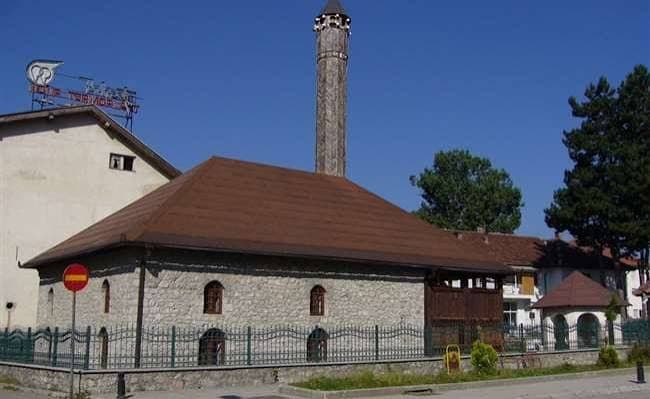
- Vizier's Mosque – Stone Beauty with Wooden Porch The oldest, most representative and architecturally most impressive Islamic sacral building in Gusinje is the famous Vizier's Mosque. Located in the heart of the city center, this sanctuary has been the central pillar of spiritual life and the most recognizable visual symbol of Gusinje for centuries. The mosque was built in 1765 by the Skadar vizier Mahmut Bušatlija, whose family had a huge political and social influence on the wider area of the Plav-Gusinje and Skadar basins. Architecturally, the Vizier's Mosque is an exceptional example of Balkan-Ottoman sacral construction: its base is built of massive, roughly hewn stone, while it is adorned with an authentic, richly carved wooden porch and a specific, slender wooden minaret (minaret). Despite numerous war destructions and historical breaks that affected this border area, the mosque was thoroughly and faithfully restored (the last time in 1994), retaining its original form, dignity and status as a legally protected cultural monument.
- Radončića (New) Mosque – Guardian of Tradition in the Old Mahala Not far from the city center, in the old and traditional center known as Radončića mahala, rises the Radončić Mosque, popularly known as the New Mosque. Built at the very end of the Ottoman rule in this area, in 1899, this place of worship is named after the prominent local Radončić family, who initiated and financed its construction, permanently tying its history to the fate of the Gusinje community. Although in later times, and especially during the last major reconstruction in 2005, it received more modern outlines and façade elements, this mosque has retained its original sacral microtopography. It is an architectural anchor around which you can still feel the pulse of the real, old Gusinje — surrounded by traditional family houses, gates and narrow streets, the New Mosque remains a living place of daily gathering, prayer and preservation of Islamic traditions and family values that have been passed down through generations.
- St. George's Church – Stone Temple and Treasury of Ancient Books In the immediate vicinity of the Vizier's Mosque, within the same central city transversal, there is the Church of St. George, the main spiritual center of the Orthodox population of the Gusinje region. Dedicated to the Holy Great Martyr and Victorious George, this church bears witness to the deep historical roots and continuity of the Orthodox population under Prokletije. The temple was built in 1926, during the reign of King Aleksandar Karađorđević, on the foundations of an older and more modest Orthodox prayer house from the 19th century. It was built in a recognizable, solid traditional style of rough and hewn stone, with a single-nave base and harmonious proportions. The interior of the church hides an exceptional iconostasis made in 1926 in the technique of oil on canvas by the famous artist Petar Čolanović, while the large bell in the port is a precious gift from the Orthodox community from nearby Selce. In addition to its architectural value, the church has the role of a real historical treasury because it preserves with great care about fifty precious Russian printed books, seven of which date back to the 18th century.
- Catholic Church of St. Anthony of Padua – Stone lighthouse in Dolja
At the very exit from the city center, about one kilometer away from the famous mountain valley of Grebaja, in the village of Dolja, there is the Catholic Church of St. Anthony of Padua. Located in ambient peace, right next to the Catholic cemetery, this sanctuary testifies to the centuries-old presence and tenacity of the Catholic (mostly Albanian) community in this area. The church was built in the period from 1933 to 1936 from finely carved stone, with a reduced but elegant architectural line and a recognizable bell tower. It is dedicated to St. Anthony of Padua, one of the most beloved and revered saints in the Catholic world. During the turbulent decades of the 20th century, the church shared the fate of its small and scattered community, and its revitalization and today's impeccably maintained appearance are a direct result of unbreakable ties with the Gusinje diaspora from all over the world, especially from the United States. Surrounded by the harsh and monumental views of Prokletije, this church is an unavoidable, equal part of the cultural and spiritual identity card of Gusinje. 5. Mosque in Vusanj – Spiritual anchor of mountain karst Deep in the bosom of the Prokletije massif, in the picturesque and mountainous village of Vusanje (Vuthaj), there is a village mosque that completes the sacral geography of this municipality. Vusanje is an area known for its rugged natural beauty, karst springs and waterfalls, but also for its proud, traditional highland population. This place of worship represents a real spiritual and social anchor for the locals of scattered mountain hamlets. In these naturally isolated areas, where winters are long and harsh, the mosque in Vusanj has historically been not only a place for performing Islamic religious ceremonies, but a key point for the preservation of national identity, morality, solidarity and tribal cohesion, testifying to the fact that the spiritual life of this region flourishes even at the highest altitudes. Conclusion The sacral heritage of Gusinje sends a unique, universal and timeless message to the entire region. On this small, geographically cramped, but spiritually infinitely vast ground, the mosques, the Orthodox temple and the Catholic Church are not dividing lines, but points of connection. The proximity of these shrines and the centuries-old peace that reigns between them are proof that multi-confessional harmony in Montenegro is not a political proclamation, but a way of life lived and defended for centuries. For this reason, Gusinje rightly bears the status of a spiritual oasis and a priceless cultural treasure trove in which diversity is woven into the very foundations of the community, making it proud and impenetrable at the foot of the eternal cursed peaks.