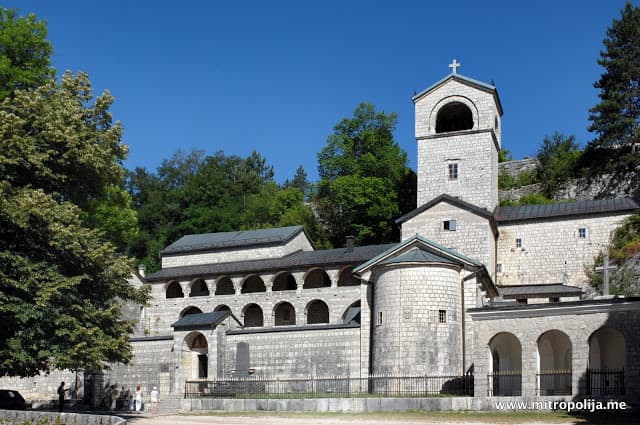
Cetinje, the historical and royal capital of Montenegro, has been profiled over the centuries as the starting point and unshakable bulwark of Montenegrin statehood, spirituality and enlightenment. Located in a karst field at the foot of the mystical mountain Lovćen, Cetinje functioned as the political and religious center of the country, which is why today it inherits an extremely layered and rich sacral heritage. In a relatively small area of the city center, monasteries, churches and high theological institutions are concentrated, which testify to more than five centuries of uninterrupted historical walk. These buildings are not only architectural monuments and places of prayer, but they are first-class cultural treasuries that preserve the memory of bishops, metropolitans and key historical breakthroughs that directly forged the Montenegrin national identity.
- Cetinje Monastery – Historical and Spiritual Lighthouse The Cetinje Monastery (Monastery of the Nativity of the Most Holy Mother of God) is the most important Orthodox monastery in Montenegro and one of the most important spiritual centers on the entire Balkan Peninsula. The original monastery was built by the lord of Zeta, Ivan Crnojević, in 1484 at the site of Ćipur, but it was completely destroyed at the end of the 17th century (1692) during the Venetian-Ottoman conflicts. Today's monumental building was erected by Bishop Danilo Petrović-Njegoš in 1701 at a new location, at the foot of the rocky hill Orlov krš, using architectural elements and carved stone from the ruined Crnojević monastery. Although during the 18th century it was again burned and ravaged by the Ottoman armies (Pasha Ćuprilić and Mahmud Pasha Bušatlija), the monastery was resurrected every time, becoming a supreme symbol of resistance, perseverance and libertarian strength of the Montenegrin people. For centuries, it functioned as the de facto seat of the state, a theocratic center from which bishops from the Petrović-Njegoš dynasty governed Montenegrin tribes and passed fateful laws. Today, in the monastery church and the rich treasury, sanctuaries of planetary importance are kept: The relics of St. Peter of Cetinje – a miracle worker, legislator and great conciliator of Montenegrin tribes. The right hand of St. John the Baptist – a pan-Christian relic with which, according to tradition, Jesus Christ was baptized in the Jordan River. A particle of the Holy Cross of the Lord – a part of the tree on which Christ was crucified. Oktoih prvoglasnik – the first printed book among the South Slavs in Cyrillic (from 1494), which testifies to the enlightenment visionary of the Crnojević dynasty.
- The Court Church on Ćipur – A Link of Two Dynasties The castle church dedicated to the Nativity of the Most Holy Mother of God on Ćipur was built in 1886 by order of Prince (later King) Nikola I Petrović-Njegoš. This elegant single-nave building with a bell tower was built on the foundations of the mentioned, original monastery of Ivan Crnojević, making this site one of the archaeologically and symbolically holiest places in Montenegro. Ćipur has a unique historical role because in one place it inextricably connects the two most important ruling dynasties of Montenegro – the Crnojević and Petrović-Njegoši. During the construction of the church, the tomb of the founder of the city, Lord Ivan Crnojević, was discovered, whose earthly remains still rest in the right wall of the nave of the church. In the interior of the church, in front of the luxurious iconostasis that is the work of Greek masters from the island of Barrosa, there are also marble tombs of King Nikola I Petrović-Njegoš and his wife Queen Milena. Their remains were transferred in 1989, with the highest state honors, from Sanremo (Italy) where they spent years in exile after World War I. The complex at Ćipur is an unavoidable memorial point of Montenegrin sovereignty and state continuity.
- Vlach Church – Witness of the First Days of Cetinje
The Vlach Church (dedicated to the Nativity of the Virgin) is considered to be the oldest preserved architectural object in the city. It was built around 1450 by immigrant cattle breeders (Vlachs, after whom it was named) under the leadership of harambasha Ivan Borojević, about thirty years before Ivan Crnojević even moved his capital to the Cetinje field. The church was originally built of wicker and covered with mud, and got its present appearance of carved stone in the middle of the 19th century (1864). What makes the Wallachian Church a world rarity is its fascinating courtyard fence. Built in 1897, this fence was forged from exactly 1,544 rifle barrels that Montenegrin warriors seized from the Ottoman armies in the great liberation battles, primarily at Grahovac and Vučji do. Each rifle barrel faces the ground, symbolizing the triumph of peace and the defense of freedom. In the courtyard of the church there are unique medieval tombstones (monumental stone tombstones in the shape of coffins), as well as the graves of historical figures, among which the grave of the famous hero and duke Joko Grujičić and the collector of folk artifacts priest Jovan Sundečić stands out. 4. Church of St. Anthony of Padua – Symbol of Multiconfessional Harmony The Catholic Church of St. Anthony of Padua was built at the beginning of the 20th century (more precisely in 1912) and is a key material proof of the cosmopolitan spirit and a high degree of religious tolerance in Cetinje. It was built after the conclusion of the historic Concordat between the Principality of Montenegro and the Holy See, and its construction was materially supported by King Nikola himself, showing deep respect for Catholic subjects and foreign diplomats who stayed in the capital. Architecturally, the church is characterized by a pure, simple, but extremely elegant neo-Gothic aesthetic that brings a recognizable Western European charm to the urban landscape of Cetinje. Although smaller in size compared to Orthodox churches, the Church of St. Anthony of Padua is a priceless stone in the mosaic of Montenegrin multiculturalism and a reminder that Cetinje has functioned for centuries as a diplomatic bridge and a space open to all religions and nations. 5. Seminary of St. Peter of Cetinje – Nursery of Literacy and Knowledge
The Cetinje Seminary of St. Peter of Cetinje is the oldest Orthodox secondary education institution in Montenegro and a pillar of the local enlightenment. It was founded by Prince Nikola in 1863 (as the Provisional Seminary), and its work was further strengthened and modernized under the auspices of the Russian imperial Romanov family at the end of the 19th century. The role of this institution goes far beyond the framework of the classical religious school. At a time when Montenegro was just developing its education system, the Seminary functioned as a key nursery of literacy, literature and general culture. Its professors and students were the initiators of the first magazines, the founders of reading rooms and the founders of the modern Montenegrin intellectual elite. Located in a monumental building of recognizable architecture near the historic center, the Seminary continues its life and a long tradition, testifying to Cetinje as a city that, in addition to the state and military, was also the top educational center of the country. Conclusion The religious and educational buildings of Cetinje form a monolithic and inseparable whole with the historical being of Montenegro. From the Cetinje Monastery, which was the nucleus around which the free state crystallized, through the archaeological testimony on Ćipur and the triumphal fence of the Vlach Church, all the way to the educational role of the Seminary and the inclusiveness of the Church of St. Anthony of Padua – each of these points tells the story of a people who survived on the combination of faith, sword, book and mutual respect. For modern visitors, a tour of these shrines offers a unique key to unlocking the authentic soul and spiritual vertical of Montenegro.