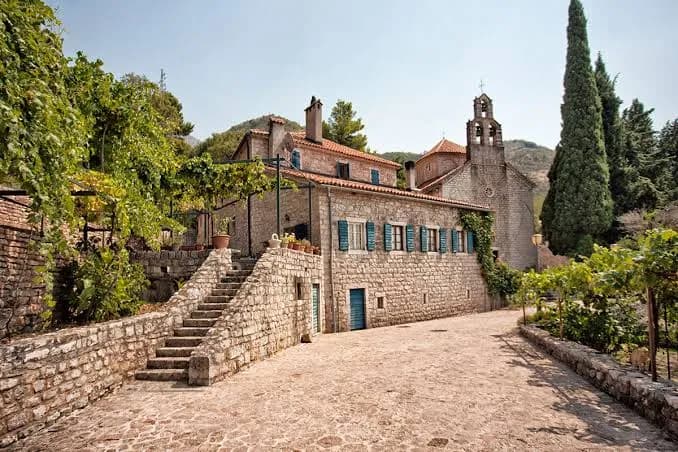
Budva, although widely recognized as the center of Montenegrin tourism, famous for its sandy beaches and dynamic nightlife, in its heart also keeps an exceptional spiritual and cultural treasure. The diversity of religious beliefs over the centuries shaped the architecture of this area, so the sacred heritage can be divided into fascinating objects in the old town center itself and monumental monastery complexes in the surrounding area.
Sacred jewels of the Old Town The largest concentration of historical churches is located within the walls of the Old Town, in a small area that testifies to the coexistence of different traditions. Church of Santa Maria in Punta: One of the oldest pre-Romanesque churches on the Montenegrin coast. It was founded by the Benedictines in 840 on the southwestern tip (punta) of the Old Town peninsula. Today, its interior is an extraordinary acoustic space that is used for classical music exhibitions and concerts within the "Grad Teatar" festival. Church of St. John the Baptist: According to tradition, this monumental Catholic church dates back to the 7th century, while it got its present appearance through later renovations. Its slender Neo-Gothic bell tower from 1867 is the dominant point of the Budva panorama. The interior holds priceless treasures, including the famous icon of the Virgin with Christ (known as Budva's Gospa or Madonna in Punta), which is considered the patroness of the city. Church of the Holy Trinity: Orthodox cathedral built on the square in front of the Citadel. It was built from 1789 to 1804, and is recognizable by its typical coastal architecture with a harmonious dome and alternating rows of white and red stone. The interior is decorated with a sumptuous iconostasis painted in the 19th century by the Greek icon painter Naum Zetiri. In front of the church is the grave of the famous writer and politician Stjepan Mitrov Ljubiša. Church of St. Sava the Sanctified: This modest but historically valuable single-nave Orthodox church was built in 1141. It was built from local white and greyish-pink stone and is located right next to the church of Santa Maria in Punta. It is interesting that throughout history it served both Orthodox and Catholic believers for a time. Remains of the early Christian basilica (5th century): Directly next to the church of St. Ivan, archaeologists discovered the remains of a monumental three-nave basilica from the early Byzantine period. Beautiful floor mosaics have been preserved, testifying that Budva was an important Christian center even in antiquity. Monastery complexes in the surroundings of Budva The hinterland of Budva and the area of Paštrović hide monasteries that were not only spiritual refuges for centuries, but also centers of literacy, resistance and diplomacy. Praskvica Monastery: Located on a hill above Miločer and Sveti Stefan, this is the historical and spiritual center of the Paštrović tribe. It got its name from a nearby spring whose water smells like peaches (local: praskve). According to legend, it was founded in the 11th century, while the first written charter dates from 1413 (the charter of Balša III). The main church is dedicated to Saint Nicholas, and within the complex there is also a rich treasury with old manuscripts, icons and the famous golden cross of Emperor Dušan. Podmaine Monastery (Podostrog): Located on the northern edge of Budva itself, under the Ostrog hill. It was built in the 17th and 18th centuries and for a long time served as the summer residence of the metropolitans of Cetinje. It was here that Petar II Petrović Njegoš wrote parts of his famous work "Mountain Wreath". The complex has two churches dedicated to the Assumption of the Blessed Virgin Mary (smaller and larger). Reževići Monastery: It is located on a picturesque cliff above the sea, near Petrovac, and dates back to the 13th century. According to tradition, King Stefan the First-crowned built the first church (Assumption of the Blessed Virgin Mary) here, while Emperor Dušan later built the church of Saint Archdeacon Stefan. The monastery is known for its traditional Pastrov architecture, a beautiful olive grove and preserved fragments of frescoes. Stanjevići Monastery: Positioned high on the slopes of the mountain massif above Budva, at about 600 meters above sea level. It was built by Duke Nikola Stanjević in the 14th century. For centuries it was a powerfully fortified seat of Montenegrin bishops from the Petrović-Njegoš dynasty. Here, bishop Petar I Petrović Njegoš (Saint Petar Cetinjski) wrote the General Montenegrin and Mountain Code in 1798 - the first written code in the modern history of Montenegro. Duljevo Monastery: It is located in the village of Kuljace, above Cape Kuljace. It originates from the 14th century (the era of Emperor Dušan) and was the metoh (estate) of the Dečani monastery. It is known for its exceptional frescoes depicting the Nemanjić lineage and is considered a place where handicrafts and spiritual silence were traditionally nurtured. Gradište Monastery: Located in Buljarica, near Petrovac. It is mentioned as early as the 14th century in the charter of Emperor Dušan. The main church is dedicated to Saint Nicholas, and the iconostasis of this monastery, which was done by the painter Vasilije Rafailović at the end of the 18th century, is considered one of the most original works of art of that era on the coast. Among other things, it contains specific depictions of saints with animal characteristics, such as Saint Christopher with a dog's head.