Podgorica, the administrative, economic and university center of Montenegro, is a city with unusual urban dynamics and a turbulent historical chronology. Located in the vast Zeta-Bjelopavlić plain, at the place where five rivers meet and intertwine - Morača, Ribnica, Zeta, Cijevna and Sitnica - this metropolis has completely changed its architectural and ideological code several times over the centuries. From the ancient Illyrian and Roman Doclea, through the medieval Ribnički trg and the four-century Ottoman Tasliža (Podgorica), all the way to Titograd, a city that was raised from the ashes after its complete destruction in the Second World War as a model of socialist modernism, Podgorica inherits fascinating spatial contrasts. Its biggest asset for the day traveler lies in its green oases and clearly defined historical districts that can be explored on foot, offering a deep insight into the transformation of Montenegrin society. In the following, we bring a fluid guide through the key phases of the day, created to reveal the hidden architectural vertical and the authentic rhythm of life on the Podgorica asphalt.
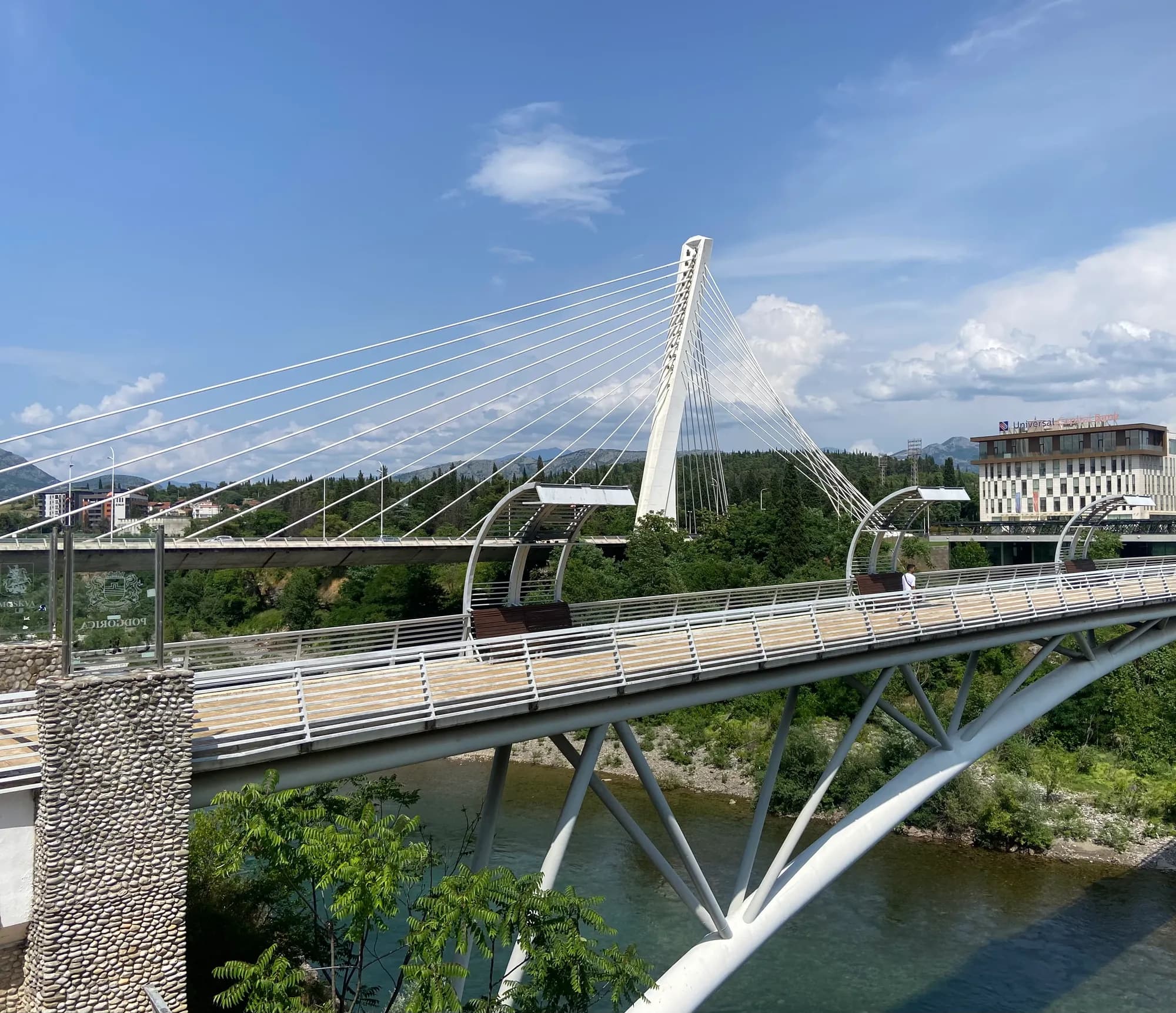
Morning in the sign of spiritual monumentality and modern city symbols Exploring the capital city is best started in the New City Center (Via Morača), a part of the city that exudes wide boulevards, modern architecture and the lively culture of drinking the first morning coffee, for which the people of Podgorica are widely known. Cathedral of the Resurrection of Christ The first must-see point is the monumental Cathedral of the Resurrection of Christ, which dominates this part of the city. Built for twenty years, from 1993 to 2013, this temple is one of the largest and most architecturally complex Orthodox sanctuaries in the Balkans. The exterior of the temple is characterized by giant blocks of rough, white marble brought from a quarry in Montenegro, while the interior is a real masterpiece of contemporary sacred art. The walls are covered with sumptuous frescoes on a golden background, rich mosaics made of natural stone and unique stonework that combines Byzantine motifs with traditional Montenegrin ornaments. Millennium Bridge and Morača Canyon A short walk from the temple towards the river bank leads to the Millennium Bridge, the most important visual and architectural symbol of modern Podgorica. Ceremonially opened on July 13, 2005, on National Day, this imposing 57-meter-high pylon with 12 cables that hold the pavement structure was designed by professor Mladen Ulićević. The bridge bridges the deep bed and canyon of the turquoise Morača River, connecting the old and new parts of the city, and is a favorite point for taking panoramic photos of the urban landscape. Noon in a green oasis and a meeting with the oldest church From the modern center, the road naturally leads to the hill that represents the geographical and ecological heart of Podgorica, and from which the entire settlement got its name in the Middle Ages - "under Gorica". Park-forest Gorica and Church of St. George Gorica Forest Park is a favorite recreation center and the green lung of the city, criss-crossed by pedestrian and bicycle paths through a dense forest of Aleppo pine and cypress. At the southern foot of this hill stands the Church of St. George, built in the 10th century. This single-nave stone building with pre-Romanesque and Romanesque style features is the oldest preserved and active sacred building on the territory of Podgorica. Inside its ancient walls are the remains of valuable frescoes from the Middle Ages, while around the church reigns the mystical peace of the old Podgorica cemetery, hidden from the hustle and bustle of the city. Afternoon on the grounds of Ottoman history: the cobblestones of Stara Varoš and Skaline By crossing the bridges on Ribnica, the tour is radically transformed, introducing the traveler to the oldest urbanized core of the city, which preserves the spirit of the bygone Ottoman ages. The clock tower and the oriental spirit of Hadji Pasha Stara Varoš is a labyrinth of narrow, winding streets, high stone walls and houses with courtyards that have defined the oriental identity of Podgorica for centuries. In the very center of this quarter proudly stands the Clock Tower, built in 1667 by order of the prominent Podgorica benefactor Hadži Pasha Osmanagić. This rough-hewn stone tower, 16 meters high, survived the devastating Allied bombings in the Second World War and is an architectural gem from the Ottoman period, with a clock mechanism that was once shipped from Austria. In the immediate vicinity are the two oldest city mosques - Starodoganjska and Skender Čauševa. Components (Skaline) – The foundation of the city At the very edge of Stara Varoš, there is the locality Sastavci, better known as Skaline among the people of Podgorica. It is a historical place where the clear mountain river Ribnica flows into the monumental Morača. In this area, there are the remains of the Turkish fortress Depedogen (Fort of Ribnica) from the 15th century, as well as the old, arched stone bridge over Ribnica, which originates from the Roman period, and which was later thoroughly restored by the Ottomans. Skaline is a cult gathering place for generations of Podgorica residents, a place where you can listen to the sound of rivers on the bare Podgorica karst. Respite with authentic Podgorica flavors A walk through Stara Varoš brings an ideal moment to meet the traditional cuisine of this region in one of the authentic local taverns. Podgorica's gastronomic tradition is a specific combination of lake, river and plain cuisine. You must try the famous carp in a pan (a specialty of Skadar carp prepared with prunes, apples and quinces), baked trout, Podgorica popeka (pork fillet stuffed with Njegu prosciutto and cream, deep-fried in a specific way), and homemade pies and raštan cooked with dried meat, which together with a glass of indigenous Podgorica vranc from the nearby Ćemovske plantations guarantees a superb gastronomic experience. Evening: Royal Kruševac and the artistic spirit of the non-aligned The day is rounded off in the most beautiful way by moving to the right bank of the Morača, to Kruševac Park, where the architectural complex of the Petrović-Njegoš dynasty is hidden among the luxurious Mediterranean trees. Petrović Castle Built in 1891 as the summer residence of the royal family, this elegant castle in the neoclassical style is today the headquarters of the Museum of Contemporary Art of Montenegro. In addition to the permanent exhibitions of local authors, this museum inherits a unique, world-renowned collection of artworks from the countries of the former Non-Aligned Movement, which was collected for decades in the former avant-garde gallery "Josip Broz Tito". A walk through the illuminated palace park, next to the art pavilion and Perjanički dom, in the evening provides a perfect space for collecting impressions. It is this constant spatial and historical dialogue between the silence of the age-old Church of St. George at the foot of Gorica, the oriental charm of the Clock Tower in Stara Varoša, the monumentality of the white marble of the Cathedral and the daring engineering flight of the Millennium Bridge, that makes Podgorica a city that is not discovered through classic tourist backdrops, but experienced through its authentic rhythm and hidden corners. One day is the perfect time frame to feel the energy of this river plain, understand its complex transformation from Titograd to a modern European town and forever take with you the spirit of a city that proudly combines historical eras under the warm Mediterranean sun. WHERE TO EXTEND THE DAY? (Alternatives for a longer stay or a different pace in the area): If you have a faster pace of touring, have a car or want to explore priceless historical and natural sites in the immediate hinterland of Podgorica, the wider territory of the capital city offers extraordinary destinations: Archaeological site Duklja (Doclea): Located only four kilometers north of the city center, at the confluence of the Zeta and Morač, this site represents the remains of the most important ancient Roman city on the soil of today's Montenegro. Duklja was a Roman municipium and the center of the province of Prevalis, the birthplace of the Roman emperor Diocletian, and today you can see here the monumental remains of Roman baths, forums, temples and palaces. Medun (Meteon) and the Museum of Marko Miljanov: It is located ten kilometers from the city, within the Kuči tribe. Medun is an ancient Illyrian city-fortress built in the 3rd century BC. At the very top of the acropolis is the Church of St. Michael the Archangel and the grave of the famous Montenegrin duke, writer, hero and symbol of morality Marko Miljanov Popović, while his birthplace houses an extremely valuable memorial museum with an ethnographic collection. Cijevna Canyon and Niagara Falls: The Cijevna River carved a deep and narrow canyon of incredible beauty in the karst field near Podgorica. The famous Podgorica Niagara Falls, an artificial dam and a natural waterfall are located on the site of Rakić House, which during the spring and early summer season offers a spectacular view of wild water and a beautiful setting for lunch in the surrounding restaurants. Izvori Mareza: Popular and extremely fresh Podgorica excursion site located in the western hinterland of the city. Mareza is the source of the river Sitnica, from which Podgorica is supplied with drinking water, and the entire area is full of dense shade, canals rich in trout and iconic national restaurants specializing in fish dishes. Brdo Ljubović: Another recognizable green hill on the south side of the city, which represents a landscaped park-forest with pedestrian paths, sports fields and a landscaped viewpoint from which a completely different panoramic view of Stara Varoš, the airport complex and the plain of Zetsko polje is offered.