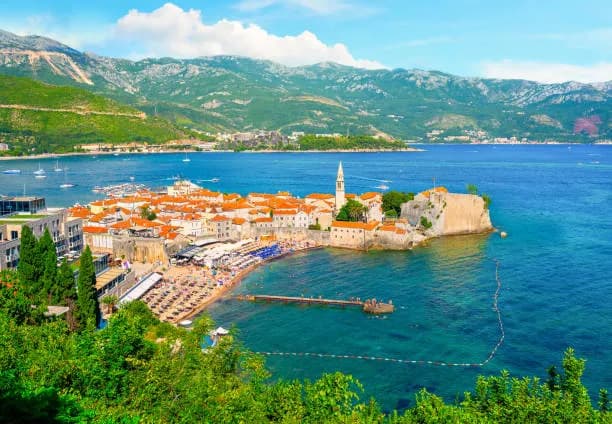
Budva, the undoubted epicenter of the Montenegrin coast, is a fascinating space where the harsh dynamics of modern tourism and over two and a half thousand years old historical verticals intertwine. Founded, according to ancient sources, as early as the 5th century BC as the Illyrian emporium of Butua, it is counted among the oldest urban entities on the Adriatic coast. Its origin is deeply woven into Greek mythology and the story of the Phoenician hero Kadmos and the goddess Harmonia, who, exiled from Thebes, found refuge in this area. Today, thanks to the extremely compact structure of its historical core, Budva offers the perfect plan for a one-day tour - a journey that takes travelers in just twenty-four hours from Roman necropolises and Venetian ramparts, through hidden rocky coves, to fashionable marinas and the most exclusive island viewpoints of the Mediterranean. Below we present a fluid guide through the key stages of the day, created to reveal the hidden soul and timeless beauty of the Budva region.
Morning Inside the Venetian Walls: The Stone Labyrinth and the Myth of the Fishes Exploring Budva is best started in the early morning, while the sun slowly illuminates the stone facades of the Old Town. This historic core, recognizable by its fortification system from the time of Venetian administration, is an urban masterpiece with narrow, winding streets, vaulted passages and beautiful squares that preserve the spirit of past centuries. The citadel and the legend of the city's origin At the highest point of the southern part of Strog grad rises the monumental Citadel - the ancient acropolis, and later the medieval fortress of Saint Mary. Throughout history, this military complex served as the last line of defense for the city. Today, within its walls, there is a precious maritime library with rare geographical maps and models of sailing ships. The upper terrace of the Citadel offers the most beautiful view of the distinctive red roofs of the Old Town, the island of Sveti Nikola and the endless blue of the Adriatic. On one of its stone walls, the famous relief of two entwined fish is imprinted. He testifies to the tragic legend about the forbidden love of the stonemason Marko and the beautiful Jelena, who, running away from their parents, threw themselves into the sea and turned into fish, while the people shouted: "As one, let there be two" (where, according to tradition, the root of the word Butua/Budva comes from). The centuries-old sacred square Just below the Citadel, there is a central square that brings together four architecturally and historically priceless sacral buildings. It is dominated by the Cathedral of St. John the Baptist, built in the 7th century, and later rebuilt with a recognizable neo-Gothic bell tower that defines the visual identity of the city; the most valuable Budva shrine is kept inside - the miraculous icon of the Virgin of Budva (Madonna in Punta). Right next to it are the Church of Santa Maria in Punta, which the Benedictines built in 840 on the very foam of the sea, the archaic Church of Saint Sava the Sanctified from the 14th century, as well as the elegant Church of the Holy Trinity from 1804, in front of whose portal rests the grave of the famous Budva writer, fighter for people's rights and politician Stjepan Mitrov Ljubiša. Walk along the coastal path: Ballerina and the secret beaches of Mogren After exiting through the northern gates of the Old Town, the road naturally leads west, along a narrow and attractive footpath carved directly into the high, layered cliffs of Spas Hill. Ballerina sculpture - Symbol of longing At the very beginning of this trail, on a stone cliff above the waves, stands a bronze sculpture of a gymnast (popularly known as the Budva Ballerina), the work of sculptor Gradimir Aleksić. This graceful figure has become the absolute visual symbol of Budva. Behind its origin is a touching local story about fidelity - a legend about a sailor's fiancee who waited for his ship on that rock for years to return from distant seas, until the waves swept her away, leaving behind an eternal monument of longing. Mogren beach The continuation of the walk along the path leads to Mogren beach (divided into two parts connected by an underground tunnel in the rock). This bay, framed by dramatic, vertical rocky walls and covered with fine, golden sand, was named after the Spanish navigator Mogrini, who in the 16th century was saved after a shipwreck by landing on this shore. It is an ideal place for a midday break, listening to the sounds of the waves and absorbing the authentic Mediterranean microclimate. Noon on the promenade: Marina and the cult of coastal gastronomy In the middle of the day, the tour returns to the urban core, i.e. to the city Marina Budva. Located right next to the northern walls of the Old Town, this harbor is a living lifeblood where indigenous wooden boats of local fishermen are moored, as well as luxurious, luxury yachts and sailboats from all over the world, creating a striking contrast between tradition and modern luxury. This is the perfect moment to experience the top gastronomy of the Budva region in one of the iconic fish restaurants located on the promenade itself. The authentic Mediterranean menu includes only freshly caught wild white fish from the Budva škoj (sea bass, bream, bream), black cuttlefish risotto, grilled octopus or mussels on the grill. All this is traditionally prepared with local olive oil, garlic and parsley, and rounded off with a glass of autochthonous Crmnica vranc or dry cruciferous vegetables. Afternoon in Miločer and the evening glow of Saint Stephen The second part of the day is reserved for leaving the hustle and bustle of the city and going ten kilometers south, along the Budva Riviera, to the most exclusive and historically fascinating part of the Montenegrin coast. Miločerski Park and Kraljičina Beach Before arriving at St. Stephen's, you must take a walk through the royal Miločerski Park. In the thirties of the 20th century, this area was arranged as a summer residence of the Karađorđević dynasty. Around the elegant castle (now a hotel) stretches a century-old forest with exotic plants - Lebanese cedars, tropical mimosas, cacti and agaves. Through the park, you can reach the famous Queen's Beach, located in a bay framed by cypresses and olive trees, named after Queen Maria Karađorđević. Viewpoint above St. Stephen's in the calm of the day The day is rounded off in the most beautiful way possible by climbing the hill above the mythical island-hotel Sveti Stefan. This fortified city-hotel, the former seat and fortress of the Paštrović seafaring tribe from the 15th century (built from the spoils seized from Turkish galleys), today represents a world-famous architectural gem. From the lookout point in the immediate vicinity of the church of St. Sava, in the moments when the sun sets behind the Adriatic horizon, there is a spectacular, panoramic view of the stone islet with red roofs, connected to the mainland by a narrow sand bar (tombola). As the first lamps are lit on the walls of Saint Stephen, this site offers an unusual visual peace and an emotional end to the journey. The combination of a harsh historical walk through the ancient layers of walls, mythical stories carved into the stone of the Citadel, the natural harmony of the sandy coves of Mogren and the timeless, aristocratic elegance of St. Stefan, positions Budva as a destination that manages to summarize the entire history of Adriatic seafaring and the Mediterranean way of life in 24 hours. It is a city that will not leave you indifferent - it captivates with its layers, forcing you to look for its ancient and centuries-old roots again and again behind the modern tourist facade. WHERE TO EXTEND THE DAY? (Alternatives for a longer stay or a different pace): If you have a faster tour pace, are planning a multi-day stay on the Budva riviera or want to explore the wild nature and hidden history in the hinterland instead of fashionable viewpoints, the municipality of Budva offers top localities: Sveti Nikola Island (Budva Hawaii): The largest island in the southern Adriatic, only a kilometer away from the Old Town. It is reached by local boats and offers high, wild cliffs, hidden beaches with crystal clear water and a dense coniferous forest that is home to deer and rare birds. Jaz Beach: One of the most spacious and attractive pebbly beaches in Montenegro, known for its clear turquoise water, but also as a historic venue for major music concerts by world stars. Podmaine Monastery (Podostrog): Located in the northern hinterland of Budva, this medieval Orthodox complex was built in the 15th century and for a long time served as the summer residence of the Metropolitans of Cetinje, Petrović-Njegoš. Inside the complex are two churches with fascinating frescoes, and here Petar II Petrović Njegoš wrote parts of the "Mountain Garland". Kosmač Fortress: An imposing Austro-Hungarian military fortification from the 19th century, located on a hill above the village of Brajići, on the historic border between Austria and Montenegro. The fortress offers an unusual architectural insight into the military strategy of that time and a monumental panoramic view of the entire Bay of Budva. Petrovac: A charming and peaceful coastal town in the south of the Budva municipality, recognizable for its reddish sandy beach, the Venetian fortress of Castio and two iconic islets - Sveta Neđelja and Katič, which stand guard at the entrance to the bay.